Distilling in the 1850s: Inside Byrn's Manual
In February 1853, New York physician M. La Fayette Byrn published a working manual for distillers and farmers — the clearest surviving picture of a working day in an 1850s distillery. This is a walk through that distillery as Byrn describes it: the deep cellar, the coal-fired still-room, the row of bubbling eggs. A modern home distiller would recognise most of it.
The book and the man
Byrn was a physician, a graduate of the University of the City of New York, who had already written on food fraud and brewing. His preface, dated New York, February 1853, complains that no usable work on distillation had appeared in America for many years, and that recent improvements had proved of little use to ordinary working distillers. So he wrote for extensive distillers and for every farmer who might wish to engage in the art: quantities in hundreds of gallons, methods step by step, economy alongside quality.
The science is pre-modern: before Pasteur, fermentation is a chemical subversion of affinities, gluten (not enzymes) converts starch to sugar, and strength is measured in Cartier and Baumé degrees and pounds-per-barrel gravity. But the practice is often remarkably sound, arrived at by generations of observation. That tension is the book's value: much right for the wrong reasons, some things dangerously wrong. The outlaw half of the story is told in Moonshine Basics & History; this guide is the working practice that guide never touches.
Down in the cellar
Byrn begins underground. The best cellar holds 55–65 °F, and to keep it there he wants it at least sixteen feet deep, roof twelve or fourteen feet high, floor covered with four feet of earth, double doors top and bottom of the stairs, entrance facing north, never south or west, air-holes closed as the outside temperature rises. It should stand distant from cart traffic and blacksmiths' forges, because vibration disturbs the liquor and frees carbonic acid gas — period chemistry, but keeping stored spirit away from vibration is still advised today.
Above ground, the still-room needs forty to fifty feet by fifteen or twenty, plus a large yard. Wash-stills were charged with 10,000 to 20,000 gallons at once. Against a hobby boiler of five to fifteen gallons, the 1850s distillery was an industrial works.
Adam's row of eggs
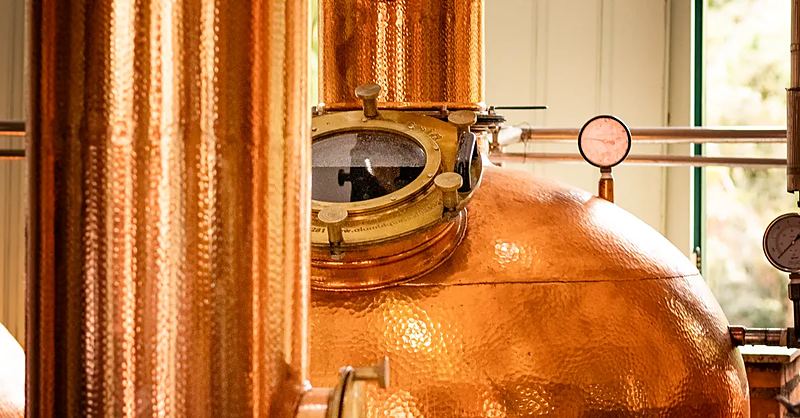
The still-room's centrepiece is French. Jean-Édouard Adam of Montpellier patented his apparatus in 1801 and again in 1805. The still is built into masonry with a fixed dome head, and from the dome a tube rises, as thick as a man's arm, into the first of a row of egg-shaped vessels. Each inlet ends at the bottom of its egg in a perforated rose, like a watering-pot rose, so vapour bubbles up through the wine in each egg.
Each egg enriches the vapour. One egg gives brandy of 14° to 16° on the Cartier hydrometer; two eggs reach 18°, Holland proof — about 42% ABV by modern conversion tables. Adam held that the more eggs, the better the rectification: the ancestor of the rule that more plates mean more reflux. Charged with brandy or feints instead of wine, the apparatus made three-six, about 85% ABV.
The main worm is plunged into wine, not water, in a sealed tun, so incoming wine preheats while condensing vapour — heat recovery, a century and a half before the term — and a second worm in cold water finishes cooling. A glass section at the worm's outlet lets the distiller watch the stream: an early sight glass, ancestor of the parrot. The eggs are the ancestors of the thumper and doubler, and of the bubble-cap plate.
The continuous still, a generation early
Byrn divides distillation into four systems — simple, wine-warming, steam and rectifiers, and continuous — and the continuous chapters are the book's most ambitious. His apparatus has seven parts: the stills that raise the steam, the column itself, a rectifier, a feed-preheating condenser, a cooler, a reservoir, and a float-worked regulator cock that keeps the feed pressure steady.
The column is counter-current: wine descends while steam ascends, forced through the wine by internal obstacles; the wine arrives near boiling and drains away at the foot as spent wash, while vapour leaves the top very rich. One column does the work of many stills with much less copper. In the rectifier, weak condensate runs back through retrograding pipes to meet rising vapour — reflux, regulating strength at will.
Byrn's thesis for the whole subject still holds up: distilling is, at root, the controlled application of heat, vaporisation, and condensation. (Byrn, PDF p. 32.) He lists seven claimed advantages, including that no cooling water at all was needed — best read as a salesman's boast. But the lineage is real: Aeneas Coffey patented his two-column continuous still in Ireland in 1830, and the modern plated column descends from this generation of invention. See Still Types and Condensers.
Floor malting with a wooden shovel
Grain arrived unmalted; making malt was the distiller's own job. It is steeped in a back seven-eighths full, covered inches deep with fresh water, for thirty to forty hours — done when a grain crushed between the hands leaves no hard particle. In summer heat the water is renewed once or twice, or it ferments. Then it is drained ten to twelve hours, heaped until palpably warm, and spread twelve to fourteen inches thick, thicker in cool weather, thinner in warm.
The white root-tip appears twenty-five to thirty hours after layering, and the malt is turned with a wooden shovel to equalise the heat. Germination is finished when rootlets reach six or seven lines — a line is a twelfth of an inch, so about half an inch — and must stop before the plume shoots. Kilning dries the malt as near 145 °F as possible, with smokeless fuel — smoke taint passes straight into the spirit. See Mashing Grain.
French mash vs English mash
The standard mash bill is twenty parts malted barley to eighty parts raw rye: rye alone ferments worse and yields less, and the mixture yields as much as if the whole had been malted.
The French method distils on the grain. One hundred kilograms of grain — eighty rye, twenty malt — go into a twelve-hectolitre back, steeped at about 110 °F, mashed to 145–155 °F, held three to four hours, diluted to about 77 °F, pitched with a litre of yeast and fermented about thirty hours. Well run, it yields forty-five to fifty litres of spirit at 19° Cartier — roughly 46% ABV — per hundred kilograms of grain.
The English method lauters: a double-bottomed tun with chaff spread on the perforated false bottom as a filter bed; two hundred kilograms of grain, mashed with eight hundred kilograms of hot water, rested an hour, drained; a second extraction with six hundred kilograms of boiling water follows. Byrn's verdict: the English method avoids distilling heavy paste, so there is no scorching risk — but it is an open question whether it needs more labour. The debate has not been settled since.
Byrn's saccharification optimum is 145 °F — and the modern optimum for beta-amylase is 140–149 °F. He landed on the right number for the wrong reason, believing gluten did the work. But the book contradicts itself: another passage directs a mash-in at 175–180 °F held for hours, which would denature the malt enzymes. Trust the 145 °F figure.
Malt's other job was mechanical: "Distillers explain thus the action of malt, by saying that it gives lightness to their paste, and prevents its falling to the bottom of their still." (Byrn, PDF p. 83.) Solids that settled and stuck would scorch and taint the spirit — and had reportedly burst stills. See Mashing Grain and Fermentation Yields.
The logged ferment
Fermentation was watched and measured. It needs at least 55 °F — below that it scarcely commences. Yeast is dosed to the liquor and the flavour wanted, and must be perfectly sweet and fresh: musty yeast taints the spirit beyond removal. "The greatest circumspection and care are necessary in regard to the quality of the ferment, if a pure and well-flavoured spirit be required." (Byrn, PDF p. 92.) See Yeast Starters.
The signs of a healthy ferment are well observed: gentle motion, small rising bubbles, whitish turbidity, then a white, dense froth; then the head subsides, the liquor clears and becomes vinous and thinner. Attenuation was measured by hydrometer, which swims much deeper in fermented liquor. The gas consists mostly of carbonic acid: it extinguishes a candle and destroys animal life — an 1850s statement of the CO₂ asphyxiation hazard. See the Safety guide.
Air is not needed — fermentation proceeds as well in closed as in open vessels, given headspace for the gas. But the book never mentions an airlock, and a sealed vessel without relief is dangerous: always vent a fermenter properly.
The log-keeping habit is the most modern thing in the book. Worts were cooled to 55 °F, pitched at 60 °F with ten stone — about 140 pounds — of fresh porter yeast; gravity was taken before pitching and every twelve hours, and recorded in a book. Attenuation ran from 28 or 30 pounds per barrel down to 2, 3 or 4, over twelve to fourteen days. Contrast Geneva: forty-eight hours, attenuated only from 45 to 15 — very imperfect and uneconomical, Byrn says, from too little yeast and too much haste. See Fermentation Temperature Control and How to Use a Hydrometer.
Cuts by bead and hydrometer
Coal was preferred over wood, whose fires swing between too much and too little heat. The fire started moderate and increased by degrees, the heat judged by laying a hand on the still body — vivid, and to be admired rather than imitated: imprecise, and a burn risk. Luting paste — half Spanish whiting, half rye-meal, mixed with water to baking-paste consistency — sealed the joints.
Double distillation was standard: wash-still to low wines, low-wine still to spirits and feints. Cuts were judged by the bead: when it collapsed at once instead of holding on the surface, it was time to swap the receiver for feints. Byrn knew the bead's weakness — grease or soap in any vessel takes off all manner of proof, so only the hydrometer can be trusted. A hydrometer tracked strength during stripping; feints were cut when the spirit turned bluish or whitish.
Rectification meant gentle fire and patience. The first distillation was drawn gently, so much essential oil never mixed with the spirit — far easier to keep out than to remove once mixed. Low wines were redistilled in a tall alembic in a water-bath, so oil and phlegm stayed in the body. Foul goods were filtered clear through the Hippocrates bag, a yard of flannel sewn into a tapering bag on a wooden hoop.
Byrn argued run speed did not affect flavour — a historical opinion, not guidance: run speed affects how heads and tails smear into the hearts. See Cuts Deep Dive, Stripping vs Spirit Runs and Foreshots. And one contradiction is worth naming: Byrn warns never to bring lighted candles near the still, then describes testing feints by touching a lighted candle to spirit poured on the still-head. Never do that. See the Safety guide.
The drinks cabinet
At the end of the working day came the drinks cabinet, at startling scale. Rum shrub was made in a 120- to 130-gallon cask: sixty-five to seventy gallons of rum, seven or eight of lemon juice, six or seven of orange juice, thirty of orange wine, pre-steeped rind, a hundred pounds of loaf sugar. Cherry brandy was made by double extraction: proof spirit on the cherries for eighteen days, then a second extraction for a month.
Irish usquebaugh was flavoured by tying saffron in a cloth and fastening it to the nose of the worm, so the spirit ran through it — an early vapour-path infusion. The aniseed cordial came with a rule that diluting past one part in five would make the oil separate and cloud the goods: a pre-scientific description of the louche effect (see Proofing Down). Peppermint cordial, Byrn says, is so easily made that every family should make it.
His four rules still read well: start with a well-cleaned spirit; give digestion the time the ingredient's oil demands; re-distil over fresh botanicals when an oil is too heavy to come over in one pass; leave the feints out. His definition of the art is neat: "For as a compound cordial is nothing more than a spirit impregnated with the essential oil of the ingredient, it becomes necessary that this spirit should have deposited its own." (Byrn, PDF p. 193.) See Flavouring FAQ and the Recipes.
What the book got wrong
The gluten theory is the deepest error: saccharification is enzymatic — diastase and amylase from the malt — not the work of gluten, and fermentation is a living process carried out by yeast. The practice was often right; the explanation was not.
Some figures are impossible. Byrn claims a hundred kilograms of potatoes may produce fifty to fifty-five litres of spirit at 75° — but potatoes are only 15–20% starch, so the theoretical maximum is roughly eleven litres of pure ethanol, about fifteen litres at 75%. His figure is about three and a half times the maximum, most likely a misprint — quoted here only as a caution: historical yields need checking against chemistry.
Then the metalwork. Period solder and pewter commonly contained lead — soldered tubes, a tin worm, a potato tub lined with lead — and lead is a cumulative poison with no place near a still. His tin-everything doctrine is likewise superseded: modern stills deliberately use clean bare copper. And brandy does not improve in glass; spirit matures only on wood (see Oak Aging).
A working day you'd recognise
By 1853, distilling was already a systematic craft: hydrometer-logged ferments, deliberate cuts, heat-recovery condensers, refluxing rectifiers, continuous columns — a decade before the Civil War, a generation before Pasteur explained yeast. A modern home distiller would recognise most of the working day: mash, ferment, strip, spirit run, cut, proof, flavour. What has changed is the understanding underneath — enzymes instead of gluten, microbiology instead of affinities — and the safety around it: no lead, no sealed vapour paths, no open flames. For the outlaw half of the story, see Moonshine Basics & History; for the craft itself, Byrn's manual remains the fullest picture of distilling becoming systematic.
Sources
- Byrn, M. La Fayette, The Complete Practical Distiller (Philadelphia: Henry Carey Baird, 1853; scanned copy is the 1868 printing). Public domain. Key passages by PDF page: cellar, pp. 15–16; still-room scale, pp. 17–18; fire and luting, pp. 18–21; Adam's egg apparatus, pp. 23–31; continuous distillation, pp. 32–48; malting, pp. 76–81; French method, pp. 85–86; English method, pp. 88–89; fermentation, pp. 90–94; rectification, pp. 95–101; malt distilling, pp. 96–98; Geneva, pp. 104–107; potato yield, p. 129; cordials, pp. 150–159 and 193–194; feints flame test, pp. 169–170. archive.org
- Wikipedia, "Edward Adam" — Jean-Édouard Adam, French chemist at Montpellier; first distillation patent 1801, second 1805. en.wikipedia.org
- The American Cyclopædia (1879), "Distillation" — independent description of Adam's egg apparatus and how each egg enriches the vapour in turn. en.wikisource.org
- Kervegant, "Spirits Analysis" (ch. XV) — the Cartier hydrometer: 0° in saturated salt solution, 10° in pure water, 44° in absolute alcohol; trois-six corresponded to 85° centesimal. bostonapothecary.com
- Scientific American Reference Book, "Specific Gravity" — comparison table: 18° Cartier = specific gravity 0.948; 19° Cartier = 0.941. chestofbooks.com
- Tralles' Table of Percentage of Alcohol — specific gravity to % ABV at 60 °F (40% ABV = SG 0.9510; 46% ABV = SG 0.9409); basis for the "Holland proof" ≈ 42% ABV and 19° Cartier ≈ 46% ABV conversions. chestofbooks.com
- Wikipedia, "Column still" — Aeneas Coffey patented the two-column continuous distillation apparatus in 1830. en.wikipedia.org
- BeerSmith, "Enzymes in Beer: Alpha and Beta Amylase" — beta-amylase most active at 60–65 °C (140–149 °F). beersmith.com
- Wikipedia, "Ligne" — the line (ligne) is one-twelfth of an inch, about 2.26 mm; six or seven lines is about half an inch. en.wikipedia.org
- Europatat, "Nutritional Composition of Potatoes" — potatoes usually contain 15–20% starch by fresh weight (Singh and Kaur, 2016); basis for the potato-yield correction. europatat.eu