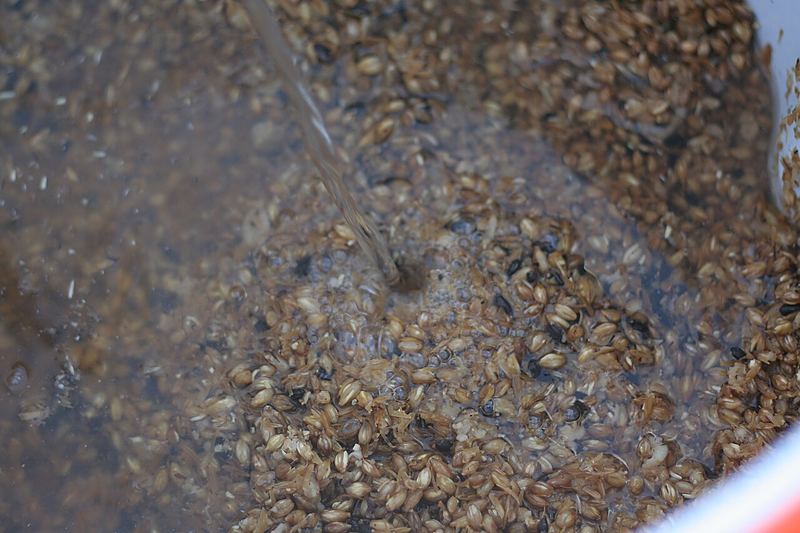
Mashing Grain: Gelatinisation and Conversion
Every grain spirit starts as a bowl of porridge. Mashing is the hot-water steep that turns the starch locked inside crushed grain into sugars a yeast can ferment — and it is the step where most of a whiskey's yield, and much of its character, is decided. Get the temperatures right and the grain's enzymes do the work.
New to grain spirits? Read the whiskey guide first for the big picture, and keep the Safety guide in mind.
What mashing does
Grain stores its energy as starch: long chains of glucose packed into hard granules inside the kernel. Yeast cannot eat starch, and the enzymes that could break it down cannot reach it while the granules are dry and wrapped in a protein and carbohydrate matrix. Mashing solves both problems with hot water: crushing exposes the granules, soaking them at the right temperature swells them open (gelatinisation), and the enzymes released from the malt then cut the exposed starch into fermentable sugars such as maltose and glucose (saccharification).
The enzymes come mostly from malted grain — grain that has been sprouted and kilned, which switches on the starch-breaking enzymes the seedling would have used to grow. Malted barley is the usual workhorse because it is enzyme-rich and its husks help with lautering. Unmalted grain, such as raw corn or rice, brings starch but little or no enzyme power, so it always needs malt — or added liquid enzymes — alongside it. A distiller's goal also differs from a brewer's: beer keeps some unfermentable dextrins for body, but a distiller wants as much starch as possible converted into fermentable sugar (see the fermentation yields guide).
Gelatinisation: opening the starch
Before any enzyme can work, the starch granules must absorb water and swell until their ordered structure breaks apart. That is gelatinisation: the granules expand, leak starch into the surrounding liquid, and the mash thickens noticeably. Alpha-amylase can nibble at ungelatinised starch, but so slowly that it hardly counts.
Each grain gelatinises over its own temperature band, not a single point. The figures below come from John Palmer's How to Brew. Treat them as approximate: other references give somewhat different bands (Briggs et al., for example, put corn at 62–77 °C).
| Grain | Gelatinisation range | Notes |
|---|---|---|
| Oats | 53–59 °C (127–138 °F) | Lowest of the common grains. |
| Rye | 57–70 °C (135–158 °F) | Wide band. |
| Wheat | 58–64 °C (136–147 °F) | Gelatinises within a normal mash. |
| Barley (unmalted) | 60–65 °C (140–150 °F) | Sits in the saccharification range. |
| Corn (maize) | 62–74 °C (143–165 °F) | Pre-cook it. |
| Rice | 68–78 °C (154–172 °F) | Cook or flake first. |
Barley, wheat, oats, and rye gelatinise at or below enzyme temperatures, so they convert in an ordinary mash. Corn and rice do not: their starches only fully open at temperatures that would destroy the enzymes, so they must be cooked separately first (see the adjuncts section).
Saccharification and the enzyme rests
Beta-amylase: the maltose maker
Beta-amylase works only from the ends of a starch chain, snipping off maltose — two glucose units at a time — and walking down the chain. It produces most of the fermentable sugar, but it cannot pass a branch point in the amylopectin molecule. It works best between 55 and 65 °C (131–150 °F) and is fragile: it begins to denature around 65 °C, and one study cited by Palmer found it down to 10% of its starting activity after 60 minutes at that temperature.
Alpha-amylase: the chain breaker
Alpha-amylase attacks starch chains at random points along their length, chopping them into shorter fragments called dextrins. That chopping rapidly thins the mash (liquefaction) and creates many more chain ends for beta-amylase to work on. It is tougher — best between 65 and 70 °C (150–158 °F), and not fully deactivated until about 80 °C (176 °F).
The supporting cast
Limit dextrinase cuts the branch points that stop the amylases, but there is little of it in the mash and it fades quickly above 65 °C. Beta-glucanases break down the gummy beta-glucans in oats, rye, and unmalted barley: a rest at 35–45 °C for about 20 minutes helps when more than about 20% of the grist is unmalted or flaked grain. A protein rest at 45–55 °C for 15–30 minutes suits moderately modified malts.
| Enzyme | Best range | What it does |
|---|---|---|
| Beta-glucanase | 35–45 °C (95–113 °F) | Breaks down gummy beta-glucans. |
| Protease / peptidase | 45–55 °C (113–131 °F) | Releases amino acids for the yeast. |
| Beta-amylase | 55–65 °C (131–150 °F) | Clips maltose off chain ends; main sugar producer. |
| Alpha-amylase | 65–70 °C (150–158 °F) | Chops chains into dextrins; thins the mash. |
| Limit dextrinase | ~55–65 °C (131–150 °F) | Cuts branch points. Scarce, heat-sensitive. |
Palmer stresses that these ranges are approximate — lab studies on purified enzymes give different optima from measurements in a real mash. What matters is the overlap: both amylases are active in the low-to-mid 60s, and that is where a mash makes the most fermentable sugar. Home-distiller consensus is to mash at the cool end, around 63–64 °C (145–148 °F), to keep beta-amylase alive as long as possible.
pH and time
Mash pH is best around 5.2–5.6 (measured at room temperature); activity falls off sharply below pH 4.5 or above 6.0 — see the water and nutrients guide. Most mashes test starch-free within 15–30 minutes, yet fermentability keeps improving after that, so a full hour's rest is the usual recommendation.
The iodine starch test
How do you know the starch is actually gone? The iodine test is the oldest and simplest check. Iodine slips inside the coiled helix of an intact amylose chain and turns a deep blue-black; once the enzymes have chopped the chains too short to hold the iodine, the colour stays amber. It takes seconds and answers one question: is there still unconverted starch in this mash?
You need a dilute iodine solution, a dropper, and a white surface — a saucer, tile, or piece of chalk. Pharmacy iodine tincture (typically 2%) is stronger than needed; dilute it to roughly 0.25%, about one part tincture to seven parts water or alcohol.
- Near the end of the rest, draw a spoonful of the liquid from the mash and let it cool — heat weakens the iodine–starch colour, so a hot sample can read falsely clear.
- Put a drop or two on the white surface, keeping grain bits and husks out: a fragment of grit will stain blue-black even in a fully converted mash.
- Add a single drop of the diluted iodine and read the colour within about 10–30 seconds.
Blue-black or dark purple means starch is still present — keep mashing and test again in 15 minutes. Red-purple means the starch is partly broken down into dextrins. No colour change — the drop stays amber — means the mash is iodine-negative.
Single infusion vs step mashing
In a single infusion mash, all the strike water goes in at once and the mash sits at one temperature for the whole rest. In a step mash, the mash is held at two or more temperatures in sequence, by adding hot water infusions or by direct heat, so each enzyme group gets its turn at its preferred temperature.
Single infusion is the standard for well-modified modern malt: today's malts are so thoroughly modified during malting that the low-temperature rests add little, and one rest in the low-to-mid 60s covers both amylases. Common temperatures run from about 65 to 69 °C (149–165 °F). A distiller chasing maximum fermentability will sit at the cool end, around 63–65 °C, and hold for a full hour or longer. Use the strike water calculator for the water temperature that lands the mash where you want it, and preheat the mash tun with hot water first — it soaks up heat too.
Step mashing earns its keep with under-modified malts, mashes heavy in unmalted grain, and any grist where you want to squeeze out the last of the fermentability. A typical two-step schedule runs a beta-amylase rest at 62–64 °C for 30–45 minutes, then steps up to 68–70 °C for 20–30 minutes so alpha-amylase can finish off the remaining starch. When stepping with direct heat, raise the temperature slowly — about 1–2 °C per minute — and stir constantly to avoid scorching.
| Schedule | Typical rests | Best for |
|---|---|---|
| Single infusion | 63–65 °C, 60 min (distiller); 66–68 °C (brewer) | Well-modified malt. |
| Two-step | 62–64 °C, 30–45 min, then 68–70 °C, 20–30 min | Maximum fermentability; under-modified malt. |
| With glucanase rest | 35–45 °C, 20 min, then rests as above | >20% rye, oats, or unmalted grain. |
| Mash-out (optional) | 75 °C (167 °F), brief | Thins the wort for lautering. |
Cooking adjuncts: corn, rice, and friends
Adjuncts are the unmalted grains that make up much of a whiskey's grist — corn in bourbon, rye in rye whiskey, wheat in wheated bourbons. They bring starch and flavour, but no enzymes — and a gelatinisation problem too: corn and rice gelatinise above the temperature where the enzymes survive, so they need a separate cooking step — a cereal mash — before they join the main mash.
Grind the adjunct fine, finer than your malt grist, and mix in about 20% of your total malt — the malt's enzymes help thin the mixture as it cooks. Add water at 4–6 litres per kilogram of adjunct to make a thin porridge, bring it up to the adjunct's gelatinisation range and hold it there for about 20 minutes, then raise it slowly to a gentle boil and hold for 20–30 minutes. By the end the mixture should be a thick, glossy goo that coats the back of a spoon. Then stir it into the main mash.
There is an easier route: buy the adjunct already gelatinised. Flaked maize, flaked rice, flaked barley, and torrified wheat have all been through heat and pressure during manufacture, so they can go straight into a single-infusion mash with no cereal step at all. Quick-cooking (instant) oats are likewise pre-gelatinised. The trade-off is cost and availability: whole corn is cheap and easy to find, flaked maize less so.
One more adjunct warning: rye and oats are rich in beta-glucans, the gummy polysaccharides that make a mash thick and sticky. A rye-heavy mash can set like cement — the beta-glucanase rest above helps, and so does keeping the rye proportion modest. Corn turns to glue when it gelatinises, so stir the cereal mash constantly while it heats.
Lautering vs fermenting on the grain
Once conversion is done, there is a fork in the road. Lautering means separating the sweet liquid (wort) from the spent grain before fermentation — draining it through the grain bed, usually with a sparge of hot water to rinse out the remaining sugars — and fermenting the clear liquid alone. Fermenting on the grain means pitching the yeast straight into the whole mash, grain and all, and separating the solids only after fermentation is finished. Brewers always lauter, because beer is drunk as it stands. Distillers have a genuine choice, because the still separates the alcohol from everything else anyway — and home-distiller consensus is that neither method is clearly better.
| Lautering (off the grain) | Fermenting on the grain | |
|---|---|---|
| Flavour | Cleaner, more delicate. | More grain flavour, often earthy or husky. |
| Yield | Some sugar stays in the grain bed. | Enzymes keep working through fermentation. |
| Fermenting | Clears faster; racking to the still is simple. | Grain cap needs managing; separating the wash is messy. |
| Mashing | More work up front: lauter tun, sparge, vorlauf. | Mash and ferment in the same vessel. |
| Still safety | Clear wash charges the boiler cleanly. | Solids can scorch on an internal element — strain well first. |
| Best for | Single malt and delicate whiskeys. | Bourbon and corn-heavy mashes. |
Corn-heavy mashes are notoriously hard to lauter — ground corn plugs the grain bed — so bourbon makers often ferment on the grain by necessity as much as by preference. Rye is worse: a high-rye mash can glue a lauter tun solid, which is why rice hulls (a flavour-neutral filter aid) are a common addition when lautering rye. Malted barley lauters easily thanks to its husks, so a single-malt spirit is the natural candidate for lautering. If you ferment on the grain, pitch a healthy, active starter (see the yeast starter guide) so the yeast beats wild microbes to the ferment.
Sources
- John Palmer, “How to Brew, Chapter 14 — How the Mash Works” — gelatinisation table; amylase ranges and denaturing; glucanase and protein rests; mash pH and time. howtobrew.com
- Braukaiser (Kai Troester), “Infusion Mashing” — single-infusion rests 65–69 °C; mash-out at 75 °C, alpha-amylase deactivated at 80 °C; conversion times; step rise rate 1–2 °C per minute. braukaiser.com
- BeerSmith (Brad Smith), “Cereal Mash Steps for All Grain Beer Brewing” — gelatinisation ranges; cereal mash procedure (20% malt, 4–6 L/kg, 20-minute hold, 20–30-minute boil); flaked grains pre-gelatinised. beersmith.com
- Briggs et al., Brewing Science and Practice, via the 2018 ADI conference presentation — alternative gelatinisation ranges (corn 62–77 °C), showing ranges vary by source. dsihiv6ixzmam.cloudfront.net
- Brewing Forward wiki, “Iodine test” — iodine diluted to ~0.25%; colour reading (blue/black starch, red dextrins, no change converted); test does not measure fermentability. brewingforward.com
- Sui Generis Brewing, “Brew Science: The Iodine Test” — iodine is toxic, never return a tested sample; keep grain bits out; read within ~10 seconds. suigenerisbrewing.com
- BYO, “Iodine Starch Testing and Defining Mash Conversion” — iodine-positive wort is purple/black, iodine-negative shows no colour change. byo.com
- HomeDistiller forum, “Scratch That Itch — Off the Grain” — on- vs off-the-grain advantages and disadvantages, including yield and separation effort. homedistiller.org
- HomeDistiller forum, “Mash straining” — distiller mash target 63–64 °C (145–148 °F); corn lautering difficulty; rice hulls as a filter aid. homedistiller.org
- HomeDistiller forum, “Fermenting differences between on grain and off grain” — on-grain flavour earthier and huskier; scorching risk from solids on elements; rye lautering difficulty. homedistiller.org