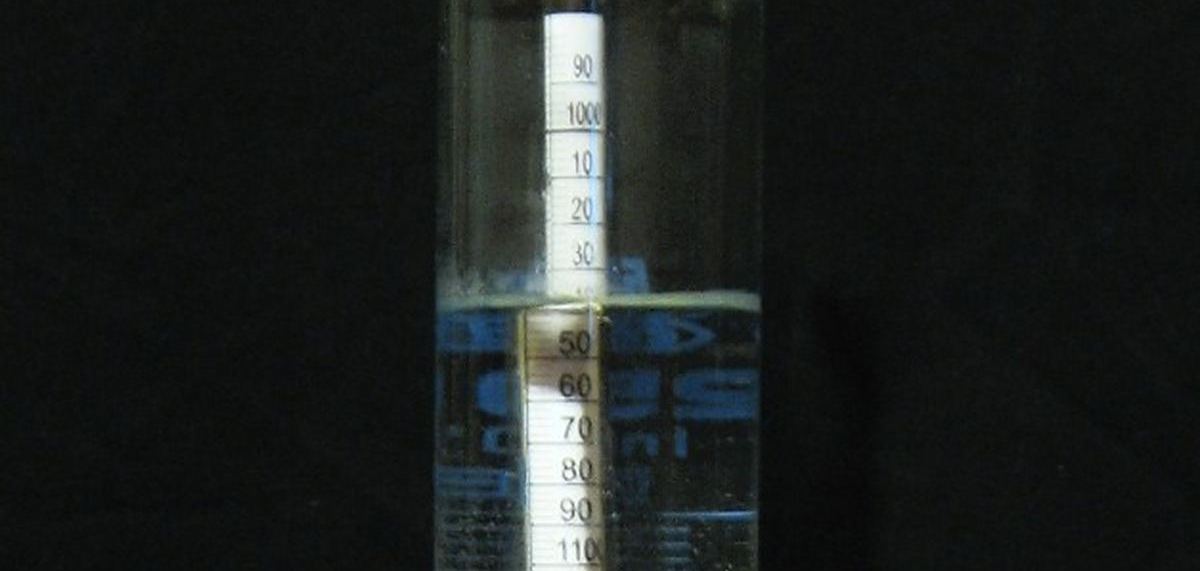
How to Use a Hydrometer
The hydrometer is the most important measuring tool in fermentation. It tells you how much sugar is in your wash, whether the yeast has finished, and — from two readings — how much alcohol the yeast made. It is a simple glass float, but a careless reading can mislead you by several percent. This guide shows how to use it properly.
What a hydrometer measures
A hydrometer is a weighted glass float with a scale inside its stem. It measures specific gravity (SG) — the density of a liquid compared with water. Pure water reads 1.000. Dissolved sugar makes a liquid denser, so a sugary wash reads above 1.000 — a typical sugar wash might start around 1.070–1.090. Alcohol is lighter than water, so as yeast converts sugar to alcohol, the reading falls, often finishing near or below 1.000.
Brewers often talk in “points” — the digits after the decimal. A reading of 1.050 is “50 points,” and a drop from 1.080 to 1.000 is a drop of 80 points.
The three scales
Most homebrewing hydrometers are triple-scale, showing three measurements on one stem:
- Specific gravity (SG) — typically 0.990–1.120. This is the scale to use for your records and calculations. Most recipes and calculators work in SG.
- Brix (°Bx) — grams of sugar per 100 g of liquid, roughly. Useful when working with fruit musts and sugar solutions, and the scale refractometers use.
- Potential alcohol (% ABV) — the alcohol the wash would reach if all the sugar fermented out. Treat this as a rough guide only: it assumes full conversion and no unfermentable material, which is not always true of a distiller's wash.
Taking a reading, step by step
- Pull a sample into a clean test jar (a tall, narrow cylinder). Never drop the hydrometer into the fermenter — you risk breaking it, contaminating the batch, and you cannot read it properly through the fermenter wall.
- Fill the jar enough to float the hydrometer clear of the bottom, with room to spare.
- Lower the hydrometer in gently and give it a spin with your fingers. Spinning knocks off bubbles clinging to the glass, which would hold the hydrometer up and give a false reading.
- Wait for it to settle, floating free of the sides and bottom of the jar.
- Read the scale at eye level (see the meniscus section below).
- Record the reading, the temperature of the sample, and the date. A reading without a temperature is only half a measurement.
- Discard the sample or return it — returning it risks contamination, so most distillers discard it or taste it for a progress check.
Reading the meniscus
Where liquid meets the hydrometer stem, surface tension pulls a thin curve of liquid up the glass. That curve is the meniscus. Read the scale where the flat surface of the liquid meets the stem — at the bottom of the curve, not the top. Reading the top of the meniscus gives a number about a point too low.
Crouch until your eye is level with the surface of the liquid. Reading from above or below introduces parallax error. If foam on a fermenting sample hides the line, wait a minute for it to settle.
Temperature correction
Liquids get less dense as they warm up, so a warm sample lets the hydrometer sink lower and reads low. Every hydrometer is calibrated at one temperature, printed on its scale or packaging. Most are calibrated at 60 °F (15.6 °C) or 68 °F (20 °C).
Within a few degrees of the calibration temperature, the difference is too small to matter. Further away it adds up: on a hydrometer calibrated at 60 °F, a sample at 80 °F (27 °C) reads about 2 points low, and one at 100 °F (38 °C) about 6 points low. The simplest fix is to cool the sample close to the calibration temperature by standing the test jar in cold water. Otherwise, note the sample's temperature and use a temperature correction calculator — the correction scales the reading by the density of water at the sample temperature relative to the calibration temperature.
Corrections get less reliable the hotter the sample, so never take a reading straight from a hot kettle. Hot liquid can also damage a glass hydrometer.
From gravity to ABV
Two readings tell you how much alcohol the yeast made: the original gravity (OG), taken before you pitch the yeast, and the final gravity (FG), taken after fermentation is truly finished (confirmed by stable readings over 2–3 days). The standard homebrew formula is:
ABV (%) = (OG − FG) × 131.25
For example, a wash that drops from 1.080 to 1.000: (1.080 − 1.000) × 131.25 = 0.080 × 131.25 = 10.5% ABV.
This formula is an estimate. It is close enough for most washes, but it under-reads at higher strengths (above roughly 7% ABV) because the relationship between gravity drop and alcohol is not perfectly linear. More accurate formulas exist — the Hall formula is widely used for washes up to about 25% ABV — and the wash ABV calculator in the Tools section applies the better math automatically. For a quick check, the ×131.25 formula is fine; for a number you will rely on, use the calculator.
The same two readings give you attenuation — the share of the sugar the yeast consumed: (OG − FG) ÷ (OG − 1) × 100. A wash that falls from 1.080 to 1.000 has attenuated 100%; one that stalls at 1.020 has attenuated 75%.
Checking your hydrometer
Hydrometers can be wrong out of the box, and the paper scale inside can slip. Check yours before trusting it: float it in distilled water at its calibration temperature. It should read exactly 1.000. If it reads 1.002, subtract 0.002 from every reading you take; if it reads 0.998, add 0.002. Write the correction on a label on the storage tube so you never forget it.
Handle the hydrometer gently — it is thin glass, and a chip or crack means it is done. Rinse it after each use and store it in its tube, upright.
Sources
- Fresh Beer Kits, “How to use a hydrometer” — reading at the bottom of the meniscus; calibration at 60 °F or 68 °F; correction magnitudes; ABV = (OG − FG) × 131.25; check in water reads 1.000. freshbeerkits.com
- ABV Calculator (Canada), “Hydrometer Temperature Correction” — correction formula using water-density ratios; reliable within about 20 °F of calibration temperature; cool hot samples first. abvcalculator.ca
- Broover, calculator suite — Hall formula accurate for 5–25% ABV where the linear ×131.25 approximation under-reads above about 7%. broover.app