Still Types: Pot vs Reflux vs Column
Every still does the same basic job — boil a fermented wash and condense the vapour back into a stronger liquid — but the shape of the still decides how much flavour survives the trip. A pot still lets most of the wash's character through. A reflux or column still strips it out. Picking the right design starts with deciding what kind of spirit you want to drink.
How a pot still works
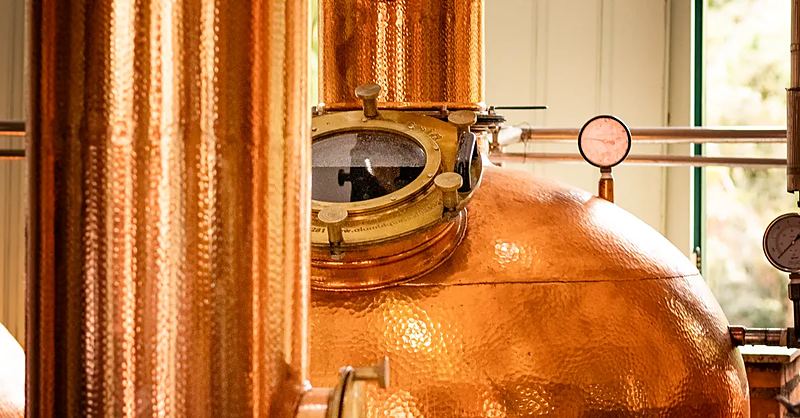
A pot still is the oldest and simplest design: a heated boiler, a head or helmet above it, a lyne arm carrying vapour to a condenser, and nothing in between to refine the vapour on its way. You charge the boiler with wash, heat it, and collect what comes over. The run has a beginning, a middle, and an end, and the distiller's job is to divide that output into fractions — foreshots, heads, hearts, and tails — as described in our guide to making cuts.
Because the vapour makes a single journey from boiler to condenser, a pot still performs roughly one distillation per run. That is both its charm and its limit. Flavour compounds from the wash — esters, heavier alcohols, grain and fruit character — pass through largely intact, which is why pot stills are the standard choice for whiskey, rum, and brandy. The trade-off is strength: a single pot-still pass typically tops out around 65–80% ABV depending on the wash and where you cut, and most whiskey comes off well below that ceiling. To reach a clean, full-flavoured spirit, pot stillers usually run twice: a fast stripping run to concentrate the wash into low wines, then a slower spirit run where the careful cuts are made.
Pot stills are forgiving to operate. There is no reflux to manage, no column to flood, and the only real controls are heat input and the speed of output. That simplicity is why most beginners start here — and why many experienced distillers never leave.
How a reflux and column still works
A reflux still adds a tall column between the boiler and the condenser, and that column changes everything. Inside it are either perforated plates or packing material — copper mesh, stainless scrubbers, ceramic saddles — that force rising vapour and falling liquid into repeated contact. Each plate or packed section acts like a small re-distillation: vapour condenses on the surface, re-boils, and climbs a little richer in alcohol each time. Four plates behave roughly like four quick pot runs stacked on top of each other; a column with twenty or more theoretical plates can push spirit past 95% ABV in a single pass.
The key control is reflux. A dephlegmator — a small condenser at the top of the column — knocks some of the vapour back down as liquid, and the operator decides how much. More reflux means more purification and a higher proof; less reflux lets more flavour through. On a packed column the same effect is achieved by controlling coolant flow to the reflux condenser. This is what makes a reflux still the right tool for vodka and gin base: turned up, it produces spirit so clean it is nearly neutral.
There are two kinds of column still, and the terms get mixed up. A continuous column (the Coffey or patent still) is fed wash nonstop and produces spirit nonstop — the workhorse of large vodka and bourbon plants, and far more still than a home distiller needs. A batch column, which is what home and craft distillers actually use, sits on a boiler charged with one batch of wash at a time. You get the plate separation without the continuous feed.
Reflux stills demand more attention than pot stills. You are managing heat, coolant flow, and reflux ratio at the same time, and the run moves more slowly. In exchange you get high proof in one pass and a much cleaner separation between fractions — the heads, hearts, and tails boundaries are sharper, which makes cutting easier.
Hybrids: the best of both
Many modern stills are hybrids: a pot boiler with a short plated or packed column on top, and a dephlegmator that can be turned up or down. Run it with the dephlegmator off and the column empty or bypassed, and it behaves like a pot still. Turn the reflux up and it behaves like a column still. Some designs let vapour go straight from the helmet to the condenser in pot mode, or up through the plates in column mode.
A hybrid is a sensible purchase if you are not yet sure what you want to make. One still can produce a characterful whiskey one weekend and a clean neutral the next. The compromise is cost and complexity: you are buying and learning two stills in one, and a hybrid rarely matches a dedicated pot still for simplicity or a dedicated tall column for maximum purity. For a beginner who wants to try everything, that trade is usually worth it.
Copper vs stainless steel
The other big material question is copper or stainless steel, and the answer is about chemistry, not looks. During fermentation, yeast produces volatile sulfur compounds — hydrogen sulfide, dimethyl sulfide, thiols — that smell of rotten eggs, cooked cabbage, or burnt rubber even at tiny concentrations. Copper reacts with those compounds in the vapour path: copper oxide on the surface binds hydrogen sulfide into copper sulfide, which sticks to the still wall and never reaches the bottle. Research published in the Journal of the Institute of Brewing found that copper reduced sulfur compounds including dimethyl trisulfide in malt whisky stills, and that the effect depended on where in the still the copper sat — copper in the vapour path, such as the lyne arm, mattered most. A 2022 review of whisky distillation science reached the same conclusion: copper contact lowers sulfur volatiles, and the spirit comes out lighter and often fruitier.
Stainless steel does none of that. It is chemically inert, so sulfur compounds pass straight through — but it is tougher, easier to clean, resistant to corrosion, and usually cheaper. It also holds up better to acidic washes and aggressive cleaning. Many distillers split the difference with a hybrid build: a stainless boiler (where durability matters most) with a copper column, copper mesh packing, or copper pieces in the vapour path (where the sulfur chemistry happens). That combination gets most of copper's benefit at much of stainless steel's price and durability.
One material to avoid entirely is aluminium. It reacts with acidic washes, offers no sulfur benefit, and has no place in a still. Lead solder is equally out of the question — any solder in a still must be lead-free, and all vapour-path materials should be food-grade.
Choosing your first still
Start from the spirit, not the equipment. If you want whiskey, rum, or brandy — anything where the flavour of the wash is the point — a pot still is the right tool. If you want vodka, gin base, or neutral spirit for liqueurs, a reflux still is the right tool. If you want both and can only buy one still, a hybrid with a dephlegmator is the practical answer.
Then think about your constraints. Heat source matters: a stovetop limits you to smaller boilers and lower power, and you need to check the total height against any range hood. A propane burner outdoors gives more power and headroom but means running outside. An internal electric element is convenient and precise but needs a suitable circuit. Condenser cooling matters too — a reflux still drinks considerably more cooling water than a pot still, so a garden hose and drain (or a recirculating pump and reservoir) are part of the real cost.
Finally, favour simple, proven designs over clever ones. A plain pot still with a worm or liebig condenser has been making good spirit for centuries. A tall packed reflux column with a needle-valve takeoff is a known quantity. Exotic designs with no track record are a gamble, and the home distilling community's forums are full of people who bought one and wished they hadn't.
Sensible sizes for a beginner
Still size means total boiler volume, not output. The spirit you keep is a small share of the wash: only the middle hearts cut is kept for drinking, and that can be as little as a third of the distillate for a quality-focused run. As a rough guide, an 8-gallon still charged with 5 gallons of a 10% ABV wash yields roughly 0.4–0.6 gallons (about 1.6–2.4 L) of 80-proof spirit.
Size the boiler to your fermenter, with headroom to spare. A boiler should only ever be charged to about 60–70% of its rated volume: wash foams as it heats, and an overfilled boiler will "puke" foam and wash up into the column or condenser. That is why the standard advice is that a 5-gallon fermenter points to an 8-gallon still, and a 10-gallon batch wants a 15-gallon boiler — a converted 15.5-gallon beer keg is a popular choice for exactly this reason. A 5-gallon batch is also about the smallest run worth doing: below that, the hearts cut gets so small that cutting accurately is difficult.
Bigger is not always better. An oversized boiler run half-full wastes heat and needs a bigger element, condenser, and workspace than you planned for. For most beginners, an 8-gallon boiler running 5-gallon batches is the sweet spot: enough spirit per run to be worth the day, small enough to heat on a stove or a modest burner, and cheap enough to walk away from if the hobby doesn't stick.
Sources
- Distillery University, "Pot Still vs. Column Still: Which One Each Spirit Needs" — pot still ceiling around 160 proof (80% ABV); two runs for whiskey; batch vs continuous columns; dephlegmator control. distilleryuniversity.com
- Prodeb, "Pot Still and Column Still distillation" — single pot run ceiling around 65–70% ABV; 20+ theoretical plates to above 95% ABV; copper and dimethyl trisulfide. prodebbrewery.com
- Proof & Principle, "Pot Still vs Column Still" — batch vs continuous operation; still type alone does not determine spirit style. proofandprinciple.com
- Mile Hi Distilling, "Copper vs. Stainless Steel Stills (Buyer's Guide)" — Harrison et al., Journal of the Institute of Brewing, on copper reducing dimethyl trisulfide and location dependence; stainless chromium oxide film; hybrid designs. milehidistilling.com
- Mile Hi Distilling, "Does Copper Improve the Taste of Spirits?" — 2022 whisky review on copper removing sulfur volatiles; copper sulfide formation; all-copper vs hybrid results. milehidistilling.com
- Mile Hi Distilling, "What Size Still Do I Need? (2026 Sizing Guide)" — 5-gallon fermenter to 8-gallon still; 60–70% fill range; 8-gallon still yielding 0.4–0.6 gallons of 80-proof spirit from 5 gallons of 10% wash; hearts as little as a third of distillate. milehidistilling.com
- Home Distiller forum, "Good size/volume for beginner pot still" — 5-gallon minimum runs; 10-gallon boiler for 5–7 gallon runs; 15.5-gallon keg popularity. homedistiller.org
- Clawhammer Supply, "Distillation Equipment — Max Fill Guidelines" — liquid must never fill the vapour cone; headroom prevents puking and pressure problems. clawhammersupply.com