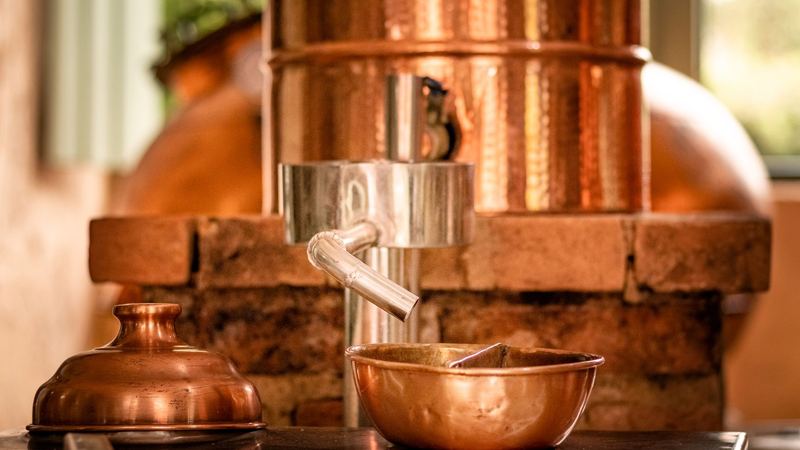
Condensers
The condenser is the last piece of hardware vapour meets before it becomes spirit, and the one most often under-built. A boiler that is too small merely limits your batch size; a condenser that is too small leaks flammable vapour into the room and caps how fast you can run. This intermediate guide is the deep version of the brief condenser list in the distillation techniques guide: how the four main designs work, how to size each one, and how to supply and manage cooling water.
What a condenser has to do
A condenser has exactly one job: remove heat from vapour fast enough that all of it turns back into liquid before it reaches the outlet. The size of that job is set by the boiler, not by the size of the charge. Every watt the element (or burner) puts into the boiler eventually arrives at the condenser as hot vapour, minus whatever heat escapes from the boiler walls and column along the way — so a 5,500 W boiler demands a condenser that can shed roughly 5,500 W of heat into cooling water. That is why condenser sizing starts from boiler power.
Three things decide whether a condenser can keep up: surface area, temperature difference, and water flow. Heat can only cross from vapour to cooling water through metal, so more tube surface means more capacity. The colder the water relative to the vapour, the faster heat crosses. And the water must carry the heat away as fast as it arrives, which is a matter of flow rate.
One arrangement rule applies to every jacketed design: cooling water should enter at the lowest point and leave at the highest, travelling in the opposite direction to the vapour. This counterflow arrangement keeps the jacket full of water and puts the coldest water where the vapour is coldest, at the outlet end.
Liebig condenser
The Liebig is the simplest jacketed condenser: a straight vapour tube running inside a slightly larger water jacket, with cooling water flowing through the annular gap between the two. Vapour enters one end, condenses against the cool inner wall as it travels, and liquid runs out the other. It is compact, cheap, and straightforward to build from plumbing parts.
The standard build is a ½-inch vapour tube inside a ¾-inch jacket, and the jacket needs to be only one size larger than the vapour tube: a fat jacket adds weight and cost without adding cooling. Length is where the capacity comes from. Among home builders, jacketed lengths run from about 24 inches to 48 inches, with most builds falling in the 24- to 36-inch range. One builder's 24-inch version on a 15-gallon boiler with a 5,500 W element handled about 65% power — roughly 3,600 W — on stripping runs before the distillate started coming out warm, while a 2-foot Liebig with a ½-inch inner tube is generally credited with handling around 1,500 W comfortably. Treat any such figure as a starting point and the available calculators as a minimum: if you have the space and the copper, a longer Liebig is cheap insurance, and it also puts the collection point further from the boiler — a real advantage on a gas-fired rig.
Two refinements improve a Liebig noticeably. A length of copper wire wound around the inner tube inside the jacket forces the cooling water into a spiral, keeping it in contact with the hot surface. And a turbulator inside the vapour tube — a twisted strip of copper ribbon, or a short length of copper scrubber near the outlet — breaks up the vapour stream and drives it against the cooled wall; one builder measured about a 30% reduction in water consumption after fitting a twisted ribbon.
Shotgun condenser
A shotgun condenser is several Liebigs in one shell: a bundle of parallel vapour tubes inside a single water jacket, with the vapour splitting across the tubes and the cooling water bathing all of them at once. The large total surface area in a short package is what makes the design so effective, and it is the usual product condenser on larger stills and reflux columns.
The common home-build sizes cluster around a 2-inch shell. Commercial 2-inch shotguns typically carry seven ⅜-inch tubes and run 12 to 20 inches long; a popular DIY variant uses four ½-inch tubes in a shell 21 to 24 inches long, which builders report knocking down a 5,500 W element with capacity to spare. The arithmetic behind those sizes comes from the home-distilling community's condenser calculator: to knock down 5,500 W takes about 108 inches of ½-inch tube, so four tubes need a jacket at least 27 inches long, while ⅜-inch tube needs about 135 inches, so seven tubes need a jacket of at least about 19 inches. Treat the calculator's answer as a floor rather than a target.
There is such a thing as too many tubes. Pack them too tightly and the cooling water cannot circulate between them, leaving dead zones; make them too small and they can clog or spit. Leave at least a small gap around every tube, and consider baffles inside the shell — plates that force the water to zigzag across the bundle rather than streaming down one side. Shotguns are usually run vertically, vapour in at the top and liquid out at the bottom, which lets condensate drain freely instead of pooling in the tubes.
Worm (coil) condenser
The worm is the oldest condenser design still in use: a lengthy coil of copper tube immersed in a vessel of cold water, vapour in at the top, liquid out at the bottom. It needs no plumbing at all — no jacket, no fittings, no running water — which is why it remains the classic choice for outdoor and off-grid rigs.
The coil is typically ⅜-inch or ½-inch soft copper tube, wound around a form such as a paint can, and the published guidance puts the length at roughly 10 to 30 feet in a 5-gallon bucket, with 20 to 30 feet the more commonly recommended range. The coil must slope steadily downward with no dips or low points: a sagging coil traps liquid, and trapped liquid blocks vapour. Fill the tube with salt or sand before winding it so the soft copper does not kink on the bends, then flush it out afterwards.
The worm's weakness is its cooling water. A still tub holds a fixed volume, and that water warms steadily through the run; as it warms, the condenser loses capacity. Managing it means topping the tub up with cold water, adding ice, or circulating the water with a small pump. A worm is at its best on a slow spirit run in cool weather; on a fast stripping run in summer, a jacketed condenser with running water will outperform it with far less fuss.
Dephlegmator (reflux condenser)
The dephlegmator is a partial condenser fitted above the packing of a reflux column, and its job is different from the other three designs: it is not meant to condense everything. Instead, it knocks a controlled fraction of the rising vapour back down the column as reflux, while the rest passes through to the product condenser. The distiller sets that fraction with the dephlegmator's cooling-water flow — more water, more reflux, higher purity and slower output.
Sizing a dephlegmator is a matter of surface area, and here the home-distilling community has published useful numbers for shotgun-style reflux condensers. For a 2-inch column, a good size has about 0.34 to 0.50 square feet of tube surface area; for a 3-inch column, about 0.80 to 1.0 square feet. The area is calculated from the tube dimensions: surface area in square feet equals π × tube outside diameter (inches) × tube length (inches) × number of tubes, divided by 144. A common error is to oversize the dephlegmator so that it can condense all the vapour, leaving nothing for the product condenser.
Dephlegmators take several forms — a short shotgun bundle is the most common in home builds, and a coil (Dimroth) design is a popular alternative. Give the dephlegmator its own water supply, separate from the product condenser, with its own valve: the two condensers need independent control.
Cooling water: mains, pumps, and reservoirs
However good the condenser, it is only as good as its cooling water.
Mains water
A garden hose or tap connection is the simplest supply: cold water in, warm water down the drain (or onto the garden). Flow is essentially unlimited, and the inlet temperature stays constant all run — typically 10–20 °C from a cold tap. A needle valve or ball valve on the inlet lets you set the flow precisely, and a flow meter, even a cheap one, removes the guesswork.
How much flow?
Flow requirements follow directly from the heat load. Water carries about 4.18 kJ of heat per kilogram for each degree Celsius it warms, which works out to roughly 1.5 litres per minute per kilowatt of condenser duty for a 10 °C rise in the water — so a 5.5 kW boiler needs around 8 litres per minute if you want the outlet water no more than 10 °C warmer than the inlet. In practice, home distillers report lower flows sufficing when they accept warmer outlet water: one builder knocked down a full 5,500 W with 3.5 litres per minute (about 1 gallon per minute) through a coil condenser. Aim for distillate coming out cool to the touch and outlet water at 30 °C or below, and treat vapour escaping from the condenser outlet or warm distillate as a sign to either increase the flow or turn the power down.
Recirculating reservoirs
Where mains water is scarce or expensive, a pump recirculating water from a reservoir is the standard answer: a submersible pond or fountain pump in a drum or tote, pushing cold water to the condenser and returning warm water to the top of the reservoir. The reservoir is a heat sink, and its size decides how long it lasts. The arithmetic is unforgiving: a 2 kW element running for two hours raises 100 litres of water by about 34 °F (19 °C), and 50 litres by twice that, about 67 °F (37 °C). A 55-gallon steel drum holds around 200 litres and is a sensible minimum for a full run; a 20-litre bucket will overheat part-way through even a modest session. A metal drum sheds heat to the air better than a plastic one. Whatever the setup, check the pump's lift rating: a pump rated at 350 gallons per hour at zero lift may deliver only 200 at a five-foot head.
Matching condenser capacity to boiler power
The matching rule is simple to state and easy to get wrong: the condenser must be able to shed the full power the boiler can deliver, at the warmest cooling water you expect, with margin to spare. Size for the maximum power, not the average — a spirit run at half power is no comfort if the condenser cannot handle heat-up or a stripping run at full power.
| Condenser (typical home build) | Indicative capacity | Notes |
|---|---|---|
| Liebig, 2 ft jacket, ½-in. tube | ~1,500 W | Small boilers, gentle runs |
| Liebig, 24-in. jacket, ¾-over-½ | ~3,600 W | Before distillate warms, at 65% of 5,500 W |
| Shotgun, 2-in. shell, 4 × ½-in. tubes, 24 in. | 5,500 W with headroom | Commonly reported by builders |
| Shotgun, 2-in. shell, 7 × ⅜-in. tubes, ~19 in. | ~5,500 W | Calculator minimum |
| Shotgun, 2-in. shell, 4 × ½-in. tubes, 21–22 in. | ~13,000 W | With adequate coolant flow |
| Worm, 20–30 ft of ⅜- or ½-in. tube | Varies with tub water | Capacity falls as the tub warms |
Every figure in that table comes with conditions attached — cold inlet water, adequate flow, and a clean condenser — and real capacity depends on the whole system, not on any single dimension. A condenser that copes in winter on cold mains water may struggle in summer on a warm reservoir, so size for your worst case.
Learn the warning signs of an overloaded condenser. Distillate coming out warm is the first hint; vapour visibly escaping from the outlet, or the smell of alcohol in the air around the still, means the condenser is already beaten. The correct response is always the same: turn the power down first, then increase the water flow. Check the numbers for your own setup with the vapour speed calculator and the heating / boil time calculator.
Vapour management basics
On a reflux still, the condenser is not just a cooler — it is the control system. Three classical arrangements manage the split between reflux and product, and all three use the dephlegmator described above:
- Cooling management (CM). The dephlegmator sits above the packing, and its cooling-water flow sets how much vapour condenses and returns down the column. More cooling water means more reflux and slower, purer output; less water means faster take-off at lower purity. The water valve is the only control.
- Vapour management (VM). Vapour leaving the packing meets a fork: one branch goes to the product condenser through a valve, the other continues up to a reflux condenser that knocks down everything that does not escape through the valve. VM is prized for its stability, because the reflux ratio holds steady once the valve is set.
- Liquid management (LM). All the vapour is condensed at the top of the column, and the liquid is then split: a valve meters part of it out as product while the rest returns down the column as reflux. LM gives precise control of the take-off rate, and is the principle behind the classic Bokakob slanted-plate head.
All three arrangements share one requirement: the reflux condenser must be able to knock down the full vapour flow when the take-off is closed, so the column can reach equilibrium at total reflux before the run begins. A dephlegmator too small to hold total reflux can never deliver that equilibration.
Sources
- HomeDistiller forum, “Sizing Lebig Condenser?” — most builders run ½-inch inside ¾-inch, lengths 24 to 48 inches, majority 24 to 36 inches; thin water jacket is more efficient; twisted-ribbon turbulator cut water use by about 30%. homedistiller.org
- HomeDistiller forum, “My first liebig build” — ¾-over-½ with a 24-inch jacket knocking down about 3,500 W on a stripping run; jacket only needs to be one size larger than the vapour tube. homedistiller.org
- HomeDistiller forum, “liebig design question” — 36-inch ¾-over-½ Liebig as a common capable size; 48-inch version efficient; 72-inch version stripping at about 6,000 W. homedistiller.org
- HomeDistiller forum, “Liebig” — 24-inch ¾-over-½ Liebig on a 5,500 W element managing about 65% power (~3,600 W) before distillate warmed; 24-inch shotgun handling 5,500 W at low water flow. homedistiller.org
- HomeDistiller forum, “Shotgun Design” — most commercial 2-inch shotguns have seven ⅜-inch tubes, 12–20 inches long; 1-foot-6-inch shotgun with 148 square inches of cooling knocking down 5,000 W easily. homedistiller.org
- HomeDistiller forum, “2" Shotgun Build” — four ½-inch tubes, 24 inches long, knocking down anything a 5,500 W element can deliver, “almost double”. homedistiller.org
- HomeDistiller forum, “Settling on a design. 3" ccvm?” — condenser calculator figures: 5,500 W needs 108 inches of ½-inch tube (27-inch shotgun with 4 tubes) or 135 inches of ⅜-inch tube (19.3-inch shotgun with 7 tubes). homedistiller.org
- HomeDistiller forum, “13kw shotgun cooler projekt” — 2-inch shell, 21–22 inches, with four ½-inch vapour tubes recommended for 13 kW with adequate coolant flow; 14 litres per minute from the calculator for 13 kW. homedistiller.org
- HomeDistiller forum, “Reflux Condenser Sizing — Packed Columns” — shotgun reflux condenser sizing: 2-inch column 0.34–0.50 ft² surface area, 3-inch column 0.80–1.0 ft²; surface area formula SA = 3.14 × Do × L × N ÷ 144; CM/VM/LM reflux column arrangements. homedistiller.org
- HomeDistiller forum, “My first attempt at a condenser coil for a boka still” — 3.5 litres per minute (1 gallon per minute) knocking down a full 5,500 W through a coil; salt-packing technique for winding coils without kinking. homedistiller.org
- Still Brewin', “How to Build a Still” — 2-foot Liebig with ½-inch inner tube handles about 1,500 W; shotgun with 6–8 inner tubes handles 5,500 W+; worm built from 20–30 feet of ⅜- or ½-inch copper tube in a 5-gallon bucket. stillbrewin.com
- Kitchen Pan Guide, “What Is a Copper Pot Still? (Condenser Specs)” — cooling-water inlet target 10–20 °C, outlet 30 °C or less; about 1.5 L/min per kW for a 10 °C rise; water carries 4.18 kJ/kg per °C. kitchenpanguide.com
- Mile Hi Distilling, “How to Set Up A Water Recirculation Chamber” — 1 kW raises water flowing at 1 litre per minute by 14 °F; 2 kW for 2 hours raises 100 litres by 33.6 °F or 50 litres by 67.2 °F; 55-gallon steel drum holds about 200 litres; metal tank sheds heat better than plastic; submersible pump wattage adds heat. milehidistilling.com
- HomeDistiller forum, “Couple questions...” — 55-gallon drum rising only a few degrees over a 4-hour run; 20-litre bucket overheating within 2 hours even with a radiator; pump delivering ~200 gph at 5 feet of lift against a 350 gph zero-lift rating. homedistiller.org
- Distilling Vol 5, “The Tier-3 Reflux Column” — dephlegmator as a partial condenser with its own cooling-water supply; controlling its water flow sets the reflux ratio; oversizing it to condense 100% of vapour is a common build error. brewing.fubsypoly.com
- HeatX, “Distillation and Alcohol Heat Exchangers” — still condensers sized on vapour rate, set by heat input, not charge volume; dephlegmator area sets the maximum reflux ratio; vapour temperature rises through the run so the condenser sees its highest load at the end. sanitaryexchangers.com