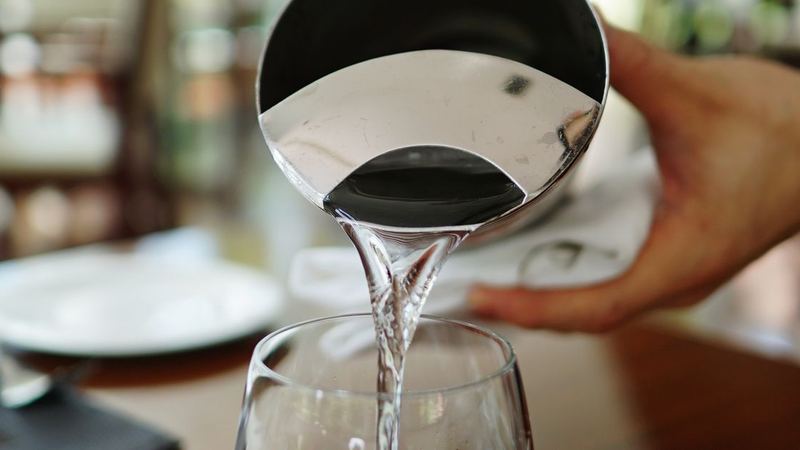
Proofing Down: Diluting to Drinking Strength
Spirit comes off the still far too strong to drink — 60% ABV from a pot still, up to 95% from a reflux column. Proofing down brings it to drinking strength with water. The arithmetic is simple, but the water you choose, the pace at which you add it, and the rest you give the spirit afterwards all shape the result.
Why proof down at all
Undiluted spirit is not just strong — it is hard to taste. At 60% ABV and above, ethanol numbs the palate and overwhelms the flavour compounds you worked to create, so a whiskey sampled at cask strength can seem oddly flat beside the same whiskey at 45%. Dilution releases aroma, softens the burn, and lets the spirit's character come forward. That is why the most common drinking strength across the hobby is 40% ABV — 80 proof in the American system, where proof is twice the ABV.
Most whiskey is proofed twice: once before it enters the barrel, to bring it below the legal ceiling for barrel entry strength (125 proof, or 62.5% ABV, in the United States), and again after aging, when spirit that has spent years at 60% or more is brought down to bottling strength, usually between 80 and 90 proof. The same logic works at home: store at barrel strength and proof individual bottles as you need them. See Aging & Storing and Oak Aging.
Choosing the water
Water is the largest single ingredient in a finished bottle. Proofing a litre of 65% spirit down to 40% adds more than half a litre of water, so it is not a neutral filler — it becomes part of the drink. The safest choices are distilled, reverse-osmosis, or deionised water: effectively free of minerals, chlorine, and anything else that could cloud the spirit or add an unwanted flavour.
Tap water deserves a second thought. Municipal water is potable, but chlorine and chloramine can add off-flavours, and dissolved minerals can throw a haze or leave sediment. If tap water is all you have, run it through a carbon filter and let it stand uncovered for a day to shed chlorine.
Limestone water
Kentucky is famous for limestone water, which picks up dissolved calcium as it filters through limestone rock. A 2024 sensory study at the University of Illinois tested the claim that it improves whiskey: water type made no significant difference to how the proofed spirits were perceived. Tradition is still a real reason to use it — but if you cannot get it, distilled water is not a compromise on flavour.
Proof slowly, in stages
The heat of mixing
Mixing ethanol and water releases heat. As the two liquids meet, some water–water and ethanol–ethanol hydrogen bonds break apart (absorbing energy) while new water–ethanol bonds form (releasing it), and the net result is exothermic: the mixture warms up, enough to feel through the wall of the vessel if you pour quickly. Adding water in stages spreads that heat out.
Layering and flavour shock
Water is denser than spirit, so water poured into a vessel of whiskey can sink and sit in layers or pockets rather than blending evenly — one distillery stirs or recirculates after each addition specifically to prevent this. The same distillery, following French Cognac and Calvados practice, proofs in two stages with months of rest in between, on the belief that spirit is "shocked" when water is introduced.
What the sensory evidence shows
The 2024 Illinois study tested fast versus slow proofing directly, adding water either by pouring it straight in or by dripping it at 0.6 mL per minute. For aged spirits, the trained panel could not reliably tell the two apart. For unaged spirit, the slow-proofed samples were perceived as sweeter and with less mouth burn. The catch: at that drip rate it took about fourteen hours to proof 300 mL of 95% spirit down to 40%. The practical middle path — home-distiller consensus, not a laboratory finding — is to proof in stages of roughly 5–10% ABV at a time, stir gently after each addition, and let the spirit return to room temperature before the next.
Measuring before and after
Proofing is a calculation followed by a measurement, and the measurement is the part that counts. Start by measuring the strength of the spirit you have, with an alcoholometer, at its calibration temperature — usually 20 °C. Warm spirit reads high and cold spirit reads low. If you cannot bring the sample to 20 °C, correct the reading with the temperature correction calculator. See How to Use an Alcoholometer.
The arithmetic is straightforward: the amount of pure alcohol stays the same when you add water; only the volume around it grows. So water to add = current volume × (current ABV ÷ target ABV − 1). For example, 2 litres at 65% taken to 40% needs 2 × (65 ÷ 40 − 1) = 1.25 litres.
| Starting strength | Water per litre to reach 45% | Water per litre to reach 40% |
|---|---|---|
| 60% | 333 mL | 500 mL |
| 65% | 444 mL | 625 mL |
| 70% | 556 mL | 750 mL |
| 80% | 778 mL | 1,000 mL |
| 90% | 1,000 mL | 1,250 mL |
Volume contraction: the mixture shrinks
There is one wrinkle. Ethanol and water do not add up to their exact combined volume — a litre of each mixed together makes slightly less than two litres, because the smaller water molecules pack into the gaps between the ethanol molecules. The contraction is small, roughly 1–2% of the final volume, but it means the formula slightly understates the water needed. Add about nine-tenths of the calculated water, let the mixture settle and come to room temperature, measure, then add the rest a little at a time until the alcoholmeter reads the target.
Proofing targets by spirit type
How far down you proof depends on the spirit. The table gives the legal minimum bottling strengths in the United States and the European Union alongside the strengths most bottles actually land at.
| Spirit | US legal minimum | EU legal minimum | Common target |
|---|---|---|---|
| Whiskey | 40% | 40% | 40–46% (cask strength 55–65%) |
| Vodka | 40% | 37.5% | 40% |
| Gin | 40% | 37.5% | 40–47% |
| Rum | 40% | 37.5% | 40% (white); 40–45% (dark) |
| Liqueurs | No minimum in the standard* | 15% | 15–30% |
*In the United States, cordials and liqueurs carry no minimum strength in their standard of identity, though they must contain at least 2.5% sugar by weight; flavoured spirits must be at least 30%. Home distillers often land a little above the legal floor for oaked spirits — 45% is a widely shared preference for whiskey that has spent time on wood — and many pour rum a touch lower, around 35–37.5%. Those are tastes, not rules: proof a small sample to two or three strengths and let your palate pick the target.
Resting and marrying
Freshly proofed spirit is rarely at its best on the day it is diluted. The water and the spirit need time to settle together — a process the trade calls marrying — and the change over the first days and weeks is noticeable: harsh edges soften, the aroma knits together, and any faint haze from the dilution itself often clears. How long is long enough depends on whom you ask, and there is no settled number. At the commercial end, one English distillery proofs its whiskey part-way, returns it to cask for a final three months of marriage, and only then proofs to bottling strength; a blending consultant who works with American distilleries recommends a minimum of one month for a married blend in tank, preferably three to six. At the home scale the common guidance is far shorter: at least 24 hours before tasting, and three to seven days before bottling.
Rest the spirit in a clean glass vessel with as little headspace as practical, sealed, in a cool, dark place — the same conditions as ordinary storage (see Aging & Storing). Do not rest spirit in plastic.
Filtration options
Filtration is optional, and for most home-distilled spirit it is unnecessary. But there are two situations where it earns its place: polishing a neutral spirit, and clearing a haze that will not settle.
Activated carbon
Passing spirit through activated carbon — usually charcoal — adsorbs trace congeners that survived distillation, particularly the heavier congeners behind rough, oily, or faintly sweet notes. It is the standard polish for vodka, and the full technique is covered in the vodka guide. The practice is recognised in American regulation: vodka treated and filtered with at least one ounce of activated carbon per 100 wine gallons of spirit may be labelled "charcoal filtered". The home version is simpler: a slow gravity pass through a column of food-grade activated carbon, rinsed before use and replaced regularly.
Limestone
Limestone appears in distilling in two different roles, and they are easy to confuse. As a water source, limestone-filtered water is simply the proofing water discussed above — water that has passed through limestone rock and picked up dissolved calcium. As a filtration medium for spirit, limestone is not a standard home practice; the trade's workhorse for clarity is chill filtration, below, and for flavour polishing it is carbon.
Chill filtration
Chill filtration is the industry's answer to haze: the spirit is cooled to around 5–10 °C and passed through a fine filter, which catches the fatty acids, proteins, and esters that precipitate out at low temperature. At home, the rough equivalent is to chill the proofed spirit in a refrigerator for a day, then pass it through a coffee filter while it is still cold. It will clear a chill haze, but the same compounds that cause the haze also contribute to mouthfeel and flavour.
Dealing with haze
The most common surprise in proofing is a spirit that was brilliantly clear at 65% turning milky or opalescent as water goes in. This is the louche effect, also called chill haze, and in most cases it is harmless and reversible.
The cause is solubility. At high strength, ethanol holds fatty acids, long-chain esters, and proteins in solution — compounds created during fermentation and picked up from the oak during aging. As the alcohol content falls, the mixture loses solvent power, and those compounds precipitate as a fine haze of droplets that scatter light. In Scotch whisky the main culprits are long-chain fatty acid esters such as ethyl dodecanoate and ethyl hexadecanoate. The effect is strongest at lower strengths and lower temperatures, and warming the glass usually restores clarity.
What to do about it:
- Accept it. Chill haze is a hallmark of non-chill-filtered spirit. If it clears on warming and the spirit tastes right, there is nothing to fix.
- Chill-filter it. Cool the batch, filter while cold, and the haze-forming compounds stay on the filter — at the cost of some mouthfeel.
- Proof to a higher strength. Haze appears most readily below about 46% ABV, so a whiskey bottled at 46–50% is far less likely to cloud than one at 40%.
- Prevent it next time. Heavy tails carry the oils that fall out of solution on dilution, so tighter cuts on the next run reduce the problem at its source.
One distinction matters: a haze that appears on proofing and clears on warming is chill haze. Cloudiness that arrives with an off smell, visible mould, or particles that do not dissolve on warming is something else — do not drink it.
Sources
- Alcohol and Tobacco Tax and Trade Bureau (TTB), "Which Alcohol Beverages Require Formula Approval?" — 40% ABV minimum bottling strength for vodka, whiskey, gin, brandy, and rum; flavoured spirits 30%. ttb.gov
- 27 CFR § 5.142 — vodka distilled at or above 95% ABV, bottled at not less than 40% ABV; "charcoal filtered" labelling for vodka treated with at least one ounce of activated carbon per 100 wine gallons. customsmobile.com
- Regulation (EC) No 110/2008, Annex II — EU minimum strengths: whisky 40%, rum, vodka, and gin 37.5%, liqueur 15%. legislation.gov.uk
- HomeDistiller wiki, "Dilution" — the most common drinking proof is 80° (40% ABV); volume contraction when ethanol and water mix. homedistiller.org
- HomeDistiller forum, "Dilution to Bottle strength" — gradual addition with rests; distilled or reverse-osmosis water preferred. homedistiller.org
- HomeDistiller forum, "Dilution from barrel proof to sipping proof" — cask strength around 125–130 proof; 45% a widely shared home preference for oaked spirits; rum often poured at 70–75 proof. homedistiller.org
- Distill Log, "Proofing down: how much water to add" — dilution formula and water-per-litre table; contraction of roughly 1–2%; add about nine-tenths of the water, measure, then top up. distillerlog.com
- Wang & Cadwallader (2024), "Effect of water type and proofing method on the perceived taste/mouthfeel properties of distilled spirits", Journal of Sensory Studies — barrel entry below 125 proof, bottling usually 80–90 proof; heat of mixing from hydrogen-bond rearrangement; slow proofing (0.6 mL/min) made unaged spirit sweeter with less burn, with no significant effect on aged spirit or from water type. onlinelibrary.wiley.com
- The Whiskey Wash, "Proofing: Watering Whiskey Down the Right Way" — limestone water and dissolved calcium; gradual addition believed to prevent saponification. thewhiskeywash.com
- Cotswolds Distillery, "A Marriage of Minds" — spirit "shocked" by water; layering from water's greater density; proofing from ~62% to 50%, three months' marriage in cask, final dilution to 46%. cotswoldsdistillery.com
- Tater-Talk, "OWA/W12 – How long does it take whiskies to marry together?" — blending consultant Nancy Fraley: minimum one month for a married blend in stainless, preferably three to six months. tater-talk.com
- Whisky Advocate, "Why Cloudy Whisky Isn't Flawed" — chill haze from fatty acids, esters, and proteins; chill filtration at around 28–30 °F; lower-proof whiskies at greater risk of precipitation. whiskyadvocate.com
- Wikipedia, "Chill filtering" — whisky cooled to 5–10 °C and passed through a fine filter; haze-forming compounds include ethyl dodecanoate and ethyl hexadecanoate. en.wikipedia.org
- Gera Tools, "Spirits ABV Reference" — typical ABV ranges: vodka 37.5–50%, gin 37.5–47%, rum 37.5–80%, whisky 40–63%, liqueurs 15–30%. geratools.com