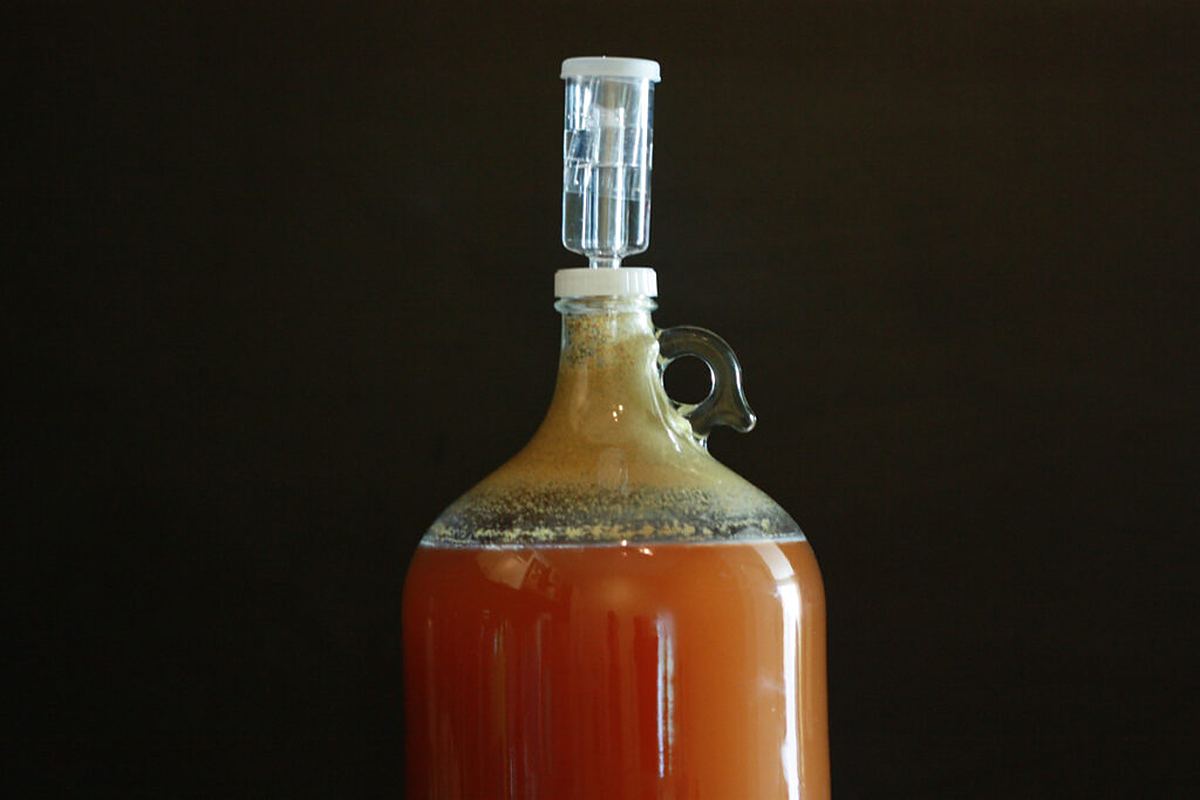
Fermentation Yields: How Much Alcohol Can a Wash Make?
No wash can ferment past a certain strength, and no amount of extra sugar changes that. The ceiling is set by chemistry on one side and by the yeast's own alcohol tolerance on the other. Understanding both limits tells you how much sugar a wash actually needs — and when adding more is just waste.
The chemistry: sugar to ethanol
Alcoholic fermentation follows the equation set out by Joseph Louis Gay-Lussac in 1810:
C6H12O6 → 2 C2H5OH + 2 CO2
One molecule of glucose becomes two molecules of ethanol and two of carbon dioxide. By mass, 180 g of glucose theoretically yields 92 g of ethanol and 88 g of carbon dioxide. That gives the theoretical maximum yield: 0.511 g of ethanol per gram of sugar. Nothing in the real world beats that number — it is the ceiling set by the atoms themselves.
Because ethanol is lighter than water (density 0.789 g/mL), the theoretical figure converts to about 15.4 g of sugar per litre for each 1% of alcohol by volume. In practice the figure is higher, because yeast does not convert every gram of sugar into ethanol.
Why real yields fall short of theory
A living yeast cell is not a chemical factory with a single output. Some of the sugar goes to building new yeast cells (biomass), some becomes glycerol, and small amounts become organic acids, acetaldehyde, and other by-products. A little ethanol also evaporates with the carbon dioxide bubbling out of the fermenter. As a result, real fermentations achieve roughly 90–95% of the theoretical yield.
That is why practical guides use a higher sugar figure: about 16.5–17.5 g of sugar per litre for each 1% ABV. EU legislation uses a conventional factor of 16.83 g/L per percent when computing potential alcohol from sugar — a legal convention, but a useful rule of thumb for planning a wash. Warmer, open fermentations sit at the higher end of the range (more evaporation and biomass); cool, controlled fermentations at the lower end.
The yeast ceiling: alcohol tolerance
The second limit is biological. Ethanol is toxic to yeast — it is, after all, a waste product the cell makes to keep its own chemistry running. As the alcohol level in a wash rises, yeast cells slow down, then stop, then die. Every strain has a tolerance limit, and no wash can ferment past it no matter how much sugar is left.
| Yeast type | Typical alcohol tolerance | Notes |
|---|---|---|
| Wild / non-Saccharomyces yeasts | 4–6% ABV | Die off early; S. cerevisiae takes over. |
| Standard ale yeasts | 10–12% ABV | Fine for beer; too low for most distilling washes. |
| Wine yeasts | 14–16% ABV | Most S. cerevisiae strains top out here. |
| Distiller's yeasts | 14–18% ABV | Selected strains; some reach 18% under good conditions. |
| Turbo yeasts | 18–20% ABV | Highest tolerance, but more off-flavours at high ABV; best for neutral spirit. |
So a wash made with a distiller's yeast realistically tops out around 14–18% ABV, and a turbo yeast can reach about 20% — Still Spirits' Classic 8 turbo, for example, is rated to produce up to 20% ABV from 8 kg of sugar in about 20 L of water over 7–10 days. Chasing the very top of the range has a cost: yeast stressed by high alcohol produces more fusel oils and off-flavours, and a stuck ferment (see Stuck Fermentations) becomes more likely. Many experienced distillers aim for 10–14% and accept a slightly smaller yield in exchange for a cleaner, more reliable ferment.
A worked example
Take a 25 L sugar wash with 6 kg of sugar, fermented with a distiller's yeast:
- Theoretical ethanol: 6,000 g × 0.511 = 3,066 g of ethanol.
- Realistic yield at 90–95% efficiency: about 2,760–2,910 g.
- As volume: divide by ethanol's density (0.789 g/mL) → about 3.5–3.7 L of pure alcohol.
- As ABV in 25 L: 3.5–3.7 L ÷ 25 L ≈ 14–15% ABV.
That sits right at the top of what a distiller's yeast can handle, so this wash is ambitious. Drop the sugar to 5 kg and the same wash lands around 12% ABV — comfortably inside the yeast's range, with a much lower risk of stalling.
Practical limits for your wash
- More sugar is not more alcohol. Sugar beyond what the yeast can ferment stays in the wash as residual sweetness — wasted money, a stuck ferment risk, and a wash that can scorch in the boiler.
- Match the sugar to the yeast. Read the tolerance on your yeast packet and plan the wash to finish 1–2% below it.
- High-gravity washes need more care — more nutrients, better temperature control, and often a yeast starter so the yeast starts strong.
- Measure, don't guess. A hydrometer reading before pitching (original gravity) and after fermenting (final gravity) tells you what the yeast actually achieved. See How to Use a Hydrometer.
Sources
- Winemaking Laboratory, “Yeast: biology and selection” — Gay-Lussac equation (180 g glucose → 92 g ethanol, 0.511 g/g); real yield 90–95% of theoretical; 16.5–17.5 g/L sugar per 1% alcohol; S. cerevisiae tolerance 14–16% (up to 18% by strain). wine.earth.ge
- Winemaking Laboratory, “Alcohol predictor” — 15.4 g/L theoretical per 1% vol; practical factor 16.5–18 g/L; EU convention 16.83 g/L. wine.earth.ge
- StillTrack, “How to Calculate Alcohol Yield From a Mash” — Gay-Lussac theoretical maximum 0.51 g/g; fermentation efficiency 90–96% for well-managed fermentations. stilltrack.app
- Still Brewin', “Yeast Guide” — alcohol tolerance by yeast type: ale 10–12%, distiller's 14–18%, turbo 18–20%. stillbrewin.com
- Still Spirits Help Centre, “Turbo Yeast Range” — Classic 8 with 8 kg sugar for high ABV (up to 20%). help.stillspirits.com