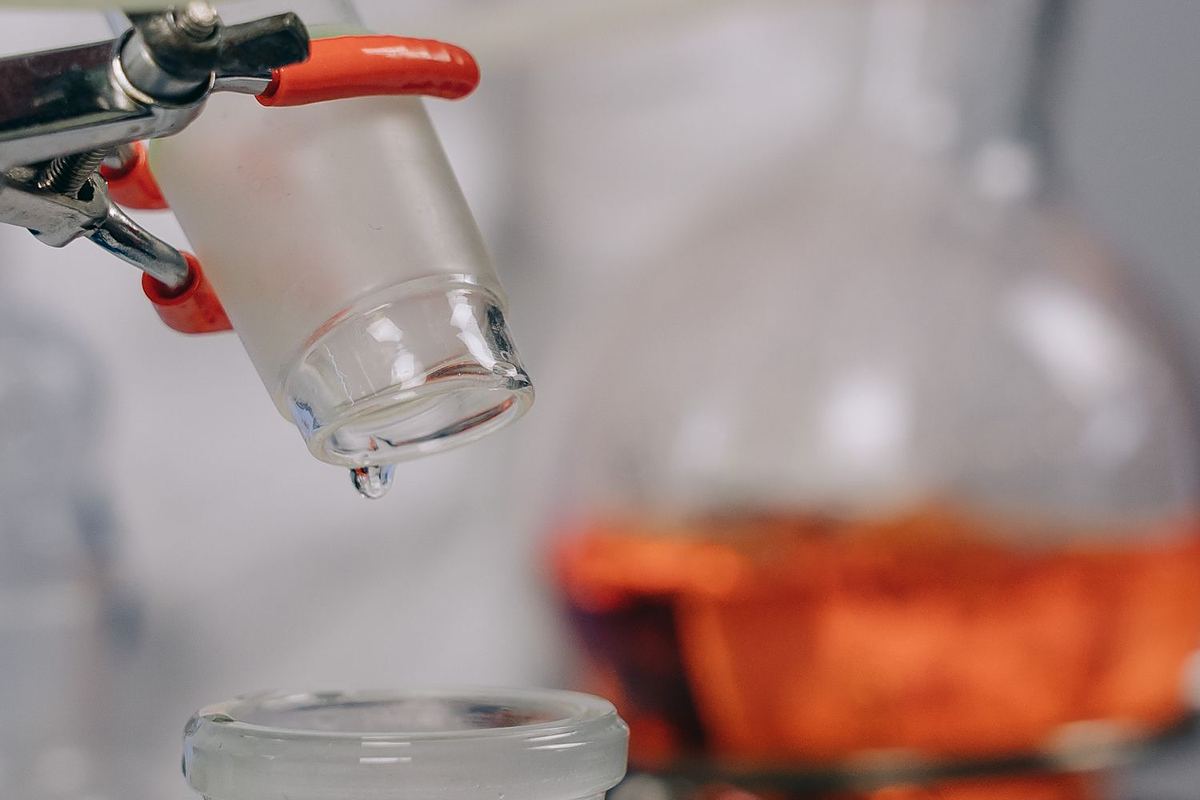
Foreshots: Why the First Drops Must Be Discarded
The first liquid to leave the condenser is not moonshine. It is a concentrated dose of the lightest, most volatile compounds in your wash — including methanol, which can blind or kill. Discarding the foreshots is the single most important safety step of any run, and it costs you almost nothing.
What foreshots are
When a wash heats up, its compounds boil off in order of boiling point, lightest first. The foreshots are the very first fraction of distillate — the liquid that comes over before the ethanol you want. They contain the most volatile compounds in the wash:
- Acetaldehyde — boiling point about 20 °C (68 °F). Sharp, green-apple, solvent smell.
- Acetone — boiling point 56.6 °C (133.8 °F). Nail-polish-remover smell.
- Methanol — boiling point 64.7 °C (148.5 °F). Toxic; see below.
- Ethyl acetate and other light esters — boiling points in the 70s °C, straddling the boundary between foreshots and heads.
Ethanol itself boils at 78.4 °C (173.1 °F). So by the time the vapour temperature reaches the ethanol range, the worst of the light compounds have already come over — provided you collected them separately and threw them away. Foreshots smell harsh, acrid, and solvent-like. If the first jar smells like chemicals, that is exactly what it is.
Methanol: the real danger
Methanol is produced in small amounts during every fermentation. It comes mainly from pectin, a substance found in fruit, so fruit washes (apple, grape, plum) contain more methanol than grain or sugar washes, which contain very little. The total amount is small — but methanol is dangerous in small amounts.
Methanol itself is only mildly intoxicating. Your liver converts it to formaldehyde and then to formic acid, which damages the optic nerve and causes a dangerous build-up of acid in the blood. As little as 10 mL of pure methanol can cause blindness, and doses from around 30 mL can be fatal. Worse, symptoms often do not appear for 6–30 hours, so a person can feel fine for most of a day before vision problems and severe illness begin.
Two points of perspective matter. First, the methanol risk in home distilling is often overstated: a normal grain or sugar wash contains so little methanol that the foreshots cut removes the bulk of it as a precaution, and the far more common dangers in distilling are fire and pressure. Second, that does not make the foreshots cut optional. It is cheap insurance against the worst-case outcome, and foreshots taste terrible anyway.
How much to discard
Guides disagree on the exact volume, because there is no single correct number — it depends on the wash, the still, and how the run is managed. The commonly quoted rules of thumb, per 5 gallons (19 L) of wash, are:
| Rule of thumb | Per 5 gal / 19 L wash | Notes |
|---|---|---|
| Minimum precaution | 50 mL | Often quoted for grain and sugar washes, which are low in pectin. |
| Standard practice | 100 mL | The most widely recommended figure for a typical wash. |
| Conservative / fruit washes | 150–200 mL | Recommended for fruit mashes, which carry more methanol, and for anyone who wants a wider safety margin. |
Scale these numbers with batch size: a 10-gallon wash gets double the 5-gallon figure, and so on. A simple per-gallon rule some distillers use is about 30–40 mL per gallon of wash, which lands in the same range.
Our recommendation for beginners: discard at least 100 mL per 5 gallons of wash, and 150–200 mL if the wash is fruit-based. When in doubt, discard more rather than less — the cost is a few mouthfuls of spirit, and the foreshots are undrinkable regardless.
Why the rules of thumb are only starting points
A fixed volume is a crude tool, because several things change how much light material a run produces:
- Wash type. Fruit mashes produce more methanol than grain or sugar washes, because fruit contains more pectin.
- Still type. A reflux still separates compounds more sharply than a pot still, so the foreshots come over in a tighter, more concentrated band. On a pot still the fractions smear together more, which argues for a larger cut.
- Run speed. Running hard and fast pushes light compounds further into the run. A slow, controlled heat-up keeps the fractions cleaner.
- Stripping vs. spirit run. On a stripping run, many distillers do not make careful cuts at all — the foreshots cut is made properly on the spirit run, when the low wines are redistilled. Either way, the foreshots must be discarded at least once before any spirit is kept for drinking.
Volume alone is not the whole story. Smell the output as the run progresses: foreshots have a sharp, chemical, solvent smell that fades as the heads begin. Temperature helps too — if your still has a vapour thermometer, the foreshots come over below about 78 °C. Use volume, smell, and temperature together, and treat the volume rule as a floor, not a target.
What to do with foreshots
Pour them down the drain with plenty of water, or keep them in a clearly labelled container for use as a cleaning solvent or firelighter — never in a container anyone could mistake for a drink. If you keep them, label the container “POISON — FORESHOTS — DO NOT DRINK” and store it away from your drinking spirit. Most distillers simply dispose of them immediately, which removes any chance of a mix-up.
Sources
- World Health Organization, “Methanol poisoning outbreaks” information note — methanol metabolism to formaldehyde and formic acid; blindness and death; delayed onset. methanol.org (WHO note, PDF)
- Evidence-Based Medicine Guidelines, “Alcohol poisoning” — as little as 10 mL of methanol may cause blindness; 30–200 mL may be lethal. evidence.unboundmedicine.com
- Still Brewin', “Making Cuts” — compound boiling points; foreshots guidance of 100 mL per 5 gallons; methanol risk in context. stillbrewin.com
- Good Ol' Moonshine, “Why Do You Throw Out The First Batch Of Moonshine?” — 150–200 mL per 5-gallon wash; 30–40 mL per gallon rule of thumb. goodolmoonshine.com
- Brewing / distilling chemistry reference, “Vol 1 — History of Distilling and the Chemistry of Transformation” — methanol from pectin demethylation; foreshots cut of about 50 mL per 5 gallons as a precaution. brewing.fubsypoly.com
- The Brew Mechanic, “How to Avoid Methanol in Distilling Alcohol Process?” — boiling-point table for cuts (acetone 56.6 °C, methanol 64 °C, ethyl acetate 77.1 °C, ethanol 78.3–81.5 °C). thebrewmechanic.com