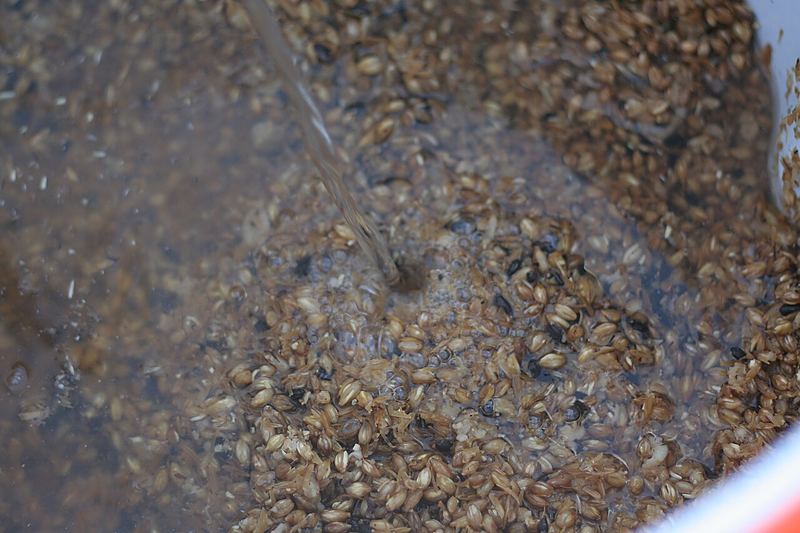
All-Grain Corn Whiskey Mash
A corn mash is a step up in effort from a sugar wash, and the reward is flavour: the finished spirit actually tastes of corn. The work is all in the mashing — cook the corn to free its starch, let malted barley convert that starch to sugar, and the fermentation takes care of itself.
Before you start: read the Safety guide first. Fermentation itself is low-risk, but distilling the result involves flammable vapour, high temperatures, and legal restrictions in many places — see the Legality guide. Bring a hydrometer and a clean fermenter: the mash schedule below leans on gravity readings throughout.
Corn starch is locked inside hard kernels and only becomes available to enzymes once it has been cooked in hot water — a process called gelatinisation — and corn carries almost no enzymes of its own, so malted barley (or commercial enzymes) must do the converting. Get those two steps right and the rest is straightforward fermentation.
The quantities below follow the published corn mash recipe from Clawhammer Supply, written there in pounds (8.5 lb corn, 2 lb malted barley, 6.5 gal water); the gelatinisation guidance for coarser corn comes from the HomeDistiller community's all-grain guides. The working ratio is roughly 1.3 lb of corn and 0.3 lb of malted barley per gallon of water, so the recipe scales cleanly to whatever your kettle holds.
Ingredients
- 3.9 kg crushed corn (flaked maize works well here)
- 0.9 kg crushed malted barley (2-row base malt)
- 1–2 packets active dry bread yeast
- Water to make up the batch volume
Method
- Heat the water to about 165 °F (74 °C), then take it off the heat. Stir in all the corn and keep stirring for a few minutes, then give it a brief stir every five minutes or so. The mixture will thicken into a gel as the starch swells — that is gelatinisation happening, and it is exactly what you want.
- Watch the temperature fall. When the mash reaches 152 °F (67 °C), stir in the malted barley, cover the pot, and leave it to rest for 90 minutes. During the rest, the enzymes from the malt convert the freed corn starch into fermentable sugar, and the thick mash thins out noticeably.
- While the mash rests, rehydrate the yeast in a cup of warm water (about 110 °F / 43 °C) with a teaspoon of sugar, so you can confirm it is alive before you commit the mash to it.
- Cool the mash to around 70 °F (21 °C) — an immersion chiller is fastest, but several hours of patient waiting works too. Strain the liquid through cheesecloth or a fine strainer, squeezing the grain to recover as much liquid as you can.
- Aerate the liquid by pouring it back and forth between two clean buckets until it froths, take a hydrometer reading, then pitch the yeast starter and move the mash to a fermenter with an airlock.
- Leave it at least a week, and up to three. While the airlock is still bubbling, fermentation is still going; distilling early leaves alcohol behind.
Why the temperatures matter
Corn starch needs real heat to gelatinise — around 180 °F (82 °C) and above for cracked corn, held for an hour or two, with finer grinds needing less time. The recipe above gets away with a 165 °F start because it uses crushed or flaked corn, which is already partly broken down; if you use coarsely cracked corn instead, hold it near 190–200 °F (88–93 °C) for up to two hours before letting it cool, or much of the starch will never convert and your gravity will come in low. The other end of the scale matters just as much: malt enzymes denature above roughly 160 °F (71 °C), which is why the barley only goes in once the mash has fallen to about 152 °F, and why the conversion rest sits in the 145–150 °F (63–66 °C) range for maximum fermentability.
How much malt is enough? Modern 2-row base malt has a diastatic power of about 150 °Lintner, and a mash needs roughly 30 °Lintner per pound of total grain for a sound conversion — so one pound of 2-row can convert about four pounds of unmalted grain. The 2 lb of malt in this recipe against 8.5 lb of corn sits comfortably inside that ratio. Note that the barley must be malted base malt: roasted malts such as caramel, biscuit, or chocolate malt have had their enzymes cooked away and will not convert anything. Liquid enzymes from a brew shop (a high-temperature alpha-amylase for the cook, then a glucoamylase at the rest) can replace the malt entirely if you prefer.
Expected results
At about 1.6 lb of grain per gallon, this mash typically lands at a starting gravity (OG) around 1.045–1.060 and finishes at roughly 6–7% alcohol by volume — all-grain mashes at 1.5–2 lb of grain per gallon generally come in at 6–8%, well below what a sugar wash reaches, because grain simply carries less fermentable sugar per pound. That is normal, not a failure: grain washes are run for flavour, and a stripping run followed by a spirit run concentrates the result. A 25 L wash at 6–7% holds roughly 1.5–1.75 L of pure alcohol, so expect a modest volume of low wines from the strip run and a small, flavourful hearts cut from the spirit run. Measure your own gravity before and after fermentation and run the numbers through the wash ABV calculator rather than trusting these round numbers.
Tips
- Stir while the corn cooks. A thick corn mash scorches easily on the bottom of a directly heated pot, and scorched mash flavours the whole batch. Stir often and keep the heat gentle once the corn is in.
- Strain before fermenting if you heat directly. Grain solids in the boiler scorch on a gas burner or an electric element; straining also makes the fermenter far easier to clean.
- An iodine test settles arguments. A drop of iodine in a spoonful of cooled mash liquid that stays brown means conversion is complete; a blue-black colour means starch remains and the rest needs more time.
Sources
- Clawhammer Supply, “Corn Mash Recipe — How To Make Corn Moonshine” — 8.5 lb crushed corn, 2 lb malted barley, 6.5 gal water; mash in at 165 °F, barley at 152 °F, 90-minute rest, pitch near 70 °F, ferment 1–3 weeks; ratio of 1.3 lb corn and 0.3 lb barley per gallon. clawhammersupply.com
- HomeDistiller, “All-Grain for beginners” — corn starch needs about 180 °F to gelatinise; enzymes denature above 160 °F; mash at 145–150 °F for maximum fermentability; 2-row malt at about 150 °Lintner, needing 30 °Lintner per pound of grain (a 4:1 ratio); roasted malts have no enzymes. homedistiller.org
- HomeDistiller forum, “Corn and Malted barley” — cracked corn held at 200 °F for 2 hours or more to gelatinise; at least 20% barley malt added at 151 °F and held 90 minutes. homedistiller.org
- HomeDistiller forum, “Recommended grain bill per volumes?” and “Corn conversion rates?” — 2–2.5 lb of grain per gallon targets about 1.070 SG and under 10% ABV; 1.5–2 lb per gallon gives about 6–8% ABV; about 6% ABV is typical for an all-grain wash. homedistiller.org and homedistiller.org