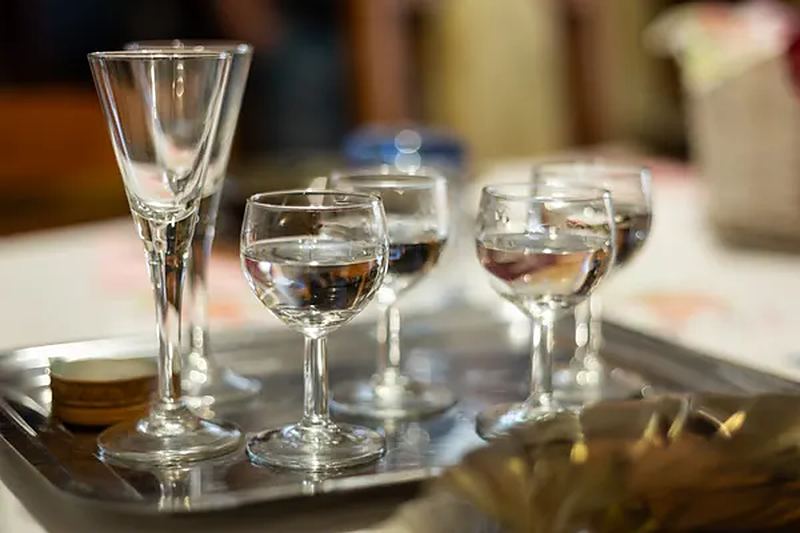
Vodka: The Neutral Spirit
Every other spirit on this site is made to keep flavour. Vodka is made to lose it. The entire craft of vodka is subtraction: ferment cleanly, distill to very high proof, filter out what remains, and dilute with good water until nothing is left but smooth ethanol. Done well, the result is not tasteless — it is quiet, and the quiet is the point.
What vodka legally is
In the United States, vodka is a type of neutral spirits. The federal rules (27 CFR § 5.142) define neutral spirits as distilled spirits produced from any suitable material at or above 95 percent alcohol by volume (190 proof), bottled at no less than 40 percent ABV. Vodka is neutral spirits that may be treated with up to 2 grams per litre of sugar and up to 1 gram per litre of citric acid — and nothing else. It may not be aged or stored in wood barrels at any time, with one narrow exception for paraffin-lined barrels used for bottled-in-bond vodka. Any other flavouring or blending material moves the product into flavoured vodka or a distilled spirits specialty product.
Until 2020, the American definition also required vodka to be "without distinctive character, aroma, taste, or color". The TTB removed that phrase in its 2020 modernization of the labelling rules, accepting that it no longer matched what drinkers expect — different vodkas do taste different, and the law now defines the category by its production standards rather than by an absence of character. In the European Union, Regulation (EU) 2019/787 defines vodka as a spirit drink made from ethyl alcohol of agricultural origin, with a minimum strength of 37.5 percent ABV; a vodka made from anything other than potatoes or cereals must say what it was produced from on the label.
Base ingredients
Because vodka is distilled to at least 95 percent ABV, the starting material matters less than it does for whiskey or rum — most of its character is stripped away on the still. Even so, the base shapes the work, and each option has its own trade-offs.
- Grain. Wheat, rye, barley, and corn are the most common bases. Grain must be mashed so its starch converts to fermentable sugar, exactly as for whiskey, which makes it the most labour-intensive route — but grain is cheap, widely available, and the classic vodka base.
- Potato. Potatoes are mostly water and starch, so they need cooking and enzyme treatment to release fermentable sugars, and a large weight of potatoes yields relatively little alcohol. Potato vodka has a reputation for a soft, slightly creamy mouthfeel, though much of that reputation rests on the finished spirit's texture rather than any flavour that survives rectification.
- Sugar. A plain sugar wash — refined sugar, water, yeast, and nutrients — is the simplest base of all: no mashing, no cooking, no starch conversion. It is the usual starting point for a home distiller learning reflux technique, and with good fermentation and careful distillation it makes a perfectly clean neutral spirit.
Whatever the base, the goal at this stage is the same: a wash with as little to remove later as possible. Off-flavours created in fermentation do not all disappear in the still, so a clean ferment is the first step toward a clean vodka.
Fermentation: clean in, clean out
For vodka, fermentation is a discipline of restraint. Use a clean-fermenting yeast, keep the temperature steady and moderate, and give the yeast enough nutrients to finish the job without stress — stressed yeast produces more higher alcohols and sulphur compounds, which are exactly the congeners a vodka maker then has to distill or filter away. A sugar wash in particular needs added nutrients, because refined sugar carries none of the nitrogen and minerals that grain or potato naturally provide; see Water & Nutrients.
Do not push the wash to extreme strength. A wash fermented to a moderate alcohol level — around 8–12 percent — ferments more completely and cleanly than one pushed to the edge of the yeast's tolerance, and the still will do the concentrating later. Let the wash finish fully and clear before running it: racking the clear liquid off the sediment keeps yeast and solids out of the boiler, where they can scorch and add burnt, rubbery notes that no amount of filtering will fix.
Reflux distillation and the azeotrope
Vodka is a reflux still's job. In a reflux column, vapour rising from the boiler meets packing or plates and condenses, then is re-boiled again and again as it climbs — each cycle is effectively another distillation, and the spirit that reaches the top is far stronger and far purer than anything a pot still produces in one pass. The goal is to push the distillate as close as possible to the physical ceiling of the ethanol-water system.
That ceiling is the azeotrope. Ethanol and water form a constant-boiling mixture at 95.6 percent ethanol by mass, which boils at about 78.1 °C — slightly lower than pure ethanol itself. Once a mixture reaches that composition, its vapour has exactly the same ethanol-to-water ratio as its liquid, so no amount of further boiling and condensing can separate them. Simple distillation therefore cannot produce ethanol stronger than about 95.6 percent by weight (roughly 97 percent by volume). Industrial producers break past that point with molecular sieves or other drying methods, but for beverage vodka there is no need: the spirit is diluted back down to bottling strength anyway.
Run the column slowly and with generous reflux. A fast, hot run smears the fractions together and carries heads and tails compounds into the hearts; a slow run with the vapour temperature held steady near the ethanol range gives the sharpest separation. Watch the temperature rather than the clock — a rise of even a degree or two at the top of the column tells you the composition of the vapour is changing.
Multiple passes and polishing
A single careful reflux run can produce good vodka, but many distillers run the spirit twice: a stripping run to concentrate the wash, then a slow spirit run through the column for the final separation. Each pass through the still removes more of the compounds you do not want — the sharp, solvent-smelling heads fractions and the heavy, oily tails — and each pass narrows the hearts cut you keep.
The usual marketing claim of "triple distilled" or "five times distilled" is less meaningful than it sounds. Under the TTB's modernized rules, one distillation means a single run through a pot still or a single run through a column of a column still — but a tall reflux column already performs many separation stages in a single pass, so counting passes is a poor measure of purity. What matters is the strength and cleanliness of the spirit that comes off, judged by smell and taste, not the number on the label.
Make the foreshots cut on the spirit run, as always, and be generous with the heads cut: vodka has nowhere to hide a solvent note, because there is no oak aging and no botanical bill to cover it. Collect in small jars, let them air briefly, and blend only the cleanest middle jars into the final spirit. See Foreshots and Cuts: A Deep Dive for the full method.
Carbon filtering
After distillation, many vodkas are passed through activated carbon — usually charcoal — which adsorbs trace congeners that survived the column. Carbon is especially good at catching the heavier organic compounds that lend rough, oily, or slightly sweet notes, and a slow pass through a deep carbon bed can noticeably smooth a spirit that is already clean. It cannot rescue a badly made spirit, though: carbon polishes; it does not rebuild.
The TTB even recognizes the practice on the label: vodka "treated and filtered with not less than one ounce of activated carbon or activated charcoal per 100 wine gallons of spirits" may be labelled "charcoal filtered". At home, the practical version is a gravity-fed column of food-grade activated carbon, run slowly — rushing the spirit through defeats the purpose, because adsorption needs contact time. Rinse new carbon well before use, and replace it regularly: spent carbon stops adsorbing and can start releasing what it caught.
Filtering is optional. A well-run reflux spirit from a clean wash may need nothing at all, and some distillers skip carbon deliberately to preserve the faint texture that distinguishes their vodka from a laboratory reagent. Taste the unfiltered spirit first, then filter a sample and compare — let the glass decide.
Dilution and bottling
The last step is the simplest and the easiest to spoil. Vodka is diluted from still strength down to bottling strength — 40 percent ABV in the United States, 37.5 percent minimum in the EU — and the water you use becomes a large fraction of what is in the bottle. Use distilled or deionised water, or at minimum soft water with no chlorine or strong mineral character: hard or chlorinated water can cloud the spirit or add flavours that the whole process was designed to remove.
Dilute gradually, in stages, and let the spirit rest after each addition. Ethanol and water contract when mixed — the final volume is slightly less than the sum of the two — so measure the strength with an alcoholmeter after the mixture has settled and reached room temperature, and correct for temperature if your meter is calibrated differently. A short rest of a few days after final dilution lets the spirit settle and any haze clear before bottling. Bottle in clean glass, seal tightly, and label with the batch and strength. Vodka does not improve in the bottle, but a well-made batch will keep indefinitely if it is sealed and stored away from light and heat.
Sources
- U.S. Code of Federal Regulations, 27 CFR § 5.142 — Neutral spirits or alcohol: vodka definition, 95% ABV distillation floor, 40% ABV bottling floor, sugar and citric acid limits, no wood storage, charcoal-filtered labelling threshold. ecfr.gov
- Difford's Guide, "Vodka Definition: Ingredients, ABV Rules, Labeling" — the TTB's 2020 removal of the "without distinctive character, aroma, taste, or color" requirement (T.D. TTB-158); EU minimum of 37.5% ABV. diffordsguide.com
- Regulation (EU) 2019/787, Annex I, category 15 — vodka: spirit drink from ethyl alcohol of agricultural origin, minimum 37.5% ABV, "produced from" labelling for non-potato/cereal bases. eur-lex.europa.eu
- Chemistry LibreTexts, "Fractional Distillation of Non-ideal Mixtures (Azeotropes)" — ethanol-water azeotrope at 95.6% ethanol by mass, boiling point 78.2 °C; distillation cannot exceed it. chem.libretexts.org
- Wine Wit and Wisdom, "New Rules Adopted for US Wine, Beer, and Spirits" (April 2020) — TTB modernization: vodka definition update and the "number of times distilled" counting rule. winewitandwisdomswe.com
- ChefsResource, "What Is the Highest Proof of Alcohol?" — 95.6% ethanol flash point of approximately 55 °F (13 °C); ethanol above 50% ABV classified as a flammable liquid. chefsresource.com