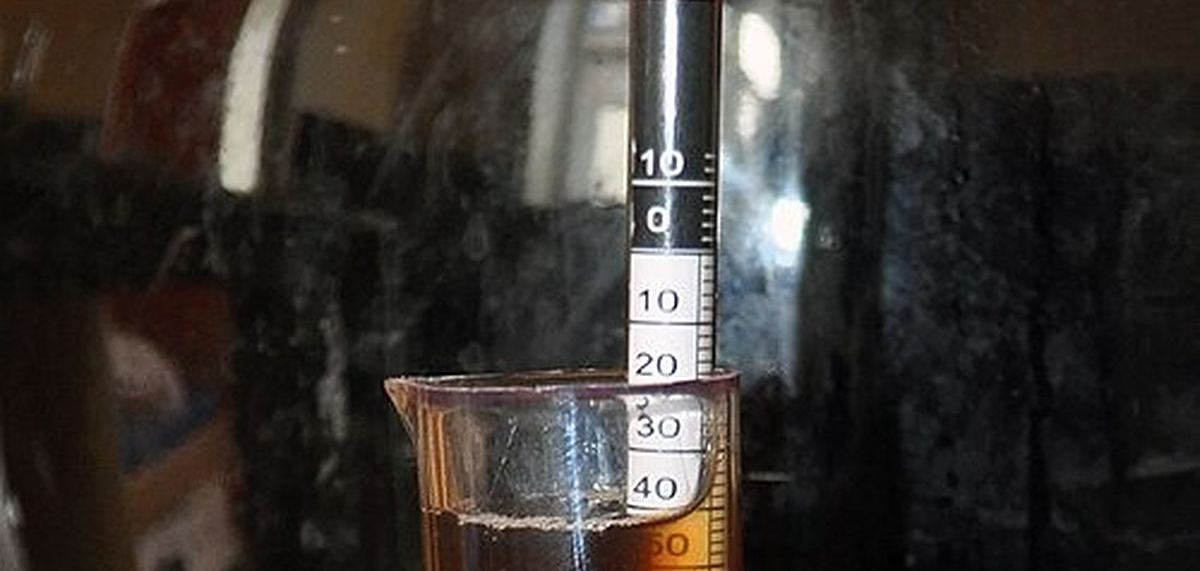
How to Use an Alcoholometer
A hydrometer tells you about your wash. An alcoholometer — also called a proof hydrometer or spirit hydrometer — tells you about your finished spirit. It floats in distilled spirit and reads the alcohol percentage directly. It is a simple tool, but it only works inside a narrow set of conditions, and using it outside them gives numbers that look precise and mean nothing.
What an alcoholometer measures
Like a hydrometer, an alcoholometer is a weighted glass float that measures density. Ethanol is lighter than water (0.789 g/mL against 0.998 g/mL at 20 °C), so the stronger the spirit, the lower the density — and the deeper the alcoholometer sinks. The scale on its stem is calibrated directly in percent alcohol by volume (% ABV), typically from 0 to 100%, so you read the strength straight off the stem with no calculation.
Most alcoholometers are calibrated at 20 °C (68 °F), the international standard reference temperature for alcohol measurement. Some, particularly older American instruments, use 60 °F (15.6 °C) as their reference temperature instead. Check the calibration temperature printed on your instrument — it matters for every reading you take.
Alcoholometer vs. hydrometer
| Hydrometer | Alcoholometer | |
|---|---|---|
| Measures | Specific gravity (density vs. water) | ABV directly |
| Used on | Wash, wort, must — before and during fermentation | Distilled spirit — after the run |
| Range | About 0.990–1.120 SG | About 0–100% ABV |
| ABV | Calculated from two readings (OG and FG) | Read directly from one reading |
You need both instruments. The hydrometer tracks fermentation; the alcoholometer measures the product. Using a brewing hydrometer on high-proof spirit gives meaningless numbers, and using an alcoholometer on a sugary wash does the same — each instrument assumes a different liquid.
When it works — and when it doesn't
An alcoholometer's scale assumes the liquid is pure ethanol and water, nothing else. Density is all it can measure, and anything dissolved in the spirit changes the density and corrupts the reading:
- Residual sugar makes the spirit denser, so the alcoholometer floats higher and under-reads the ABV. This is why an alcoholometer cannot measure a wash, a liqueur, or any sweetened spirit.
- Flavourings, glycerol, and dissolved solids — essences, sugars, fruit solids — all skew the reading. Measure the ABV before adding any essence or sweetener.
- Cloudy or unfiltered spirit with suspended solids can throw the reading off. Filter the sample if it is cloudy.
- Very low ABV liquids (below about 20%) are near the bottom of the scale, where the instrument is least precise. Low wines from a stripping run can be measured, but treat the number as approximate.
An alcoholometer also cannot detect methanol, fusel oils, or other congeners. It measures density, not safety. A spirit can read a perfect 40% ABV and still be badly made.
Taking a reading, step by step
- Take a sample of clear, filtered spirit into a tall, clean test jar. Never float the alcoholometer directly in a collection jar or parrot unless the parrot is designed for it — and even then, a test-jar reading is more reliable.
- Bring the sample to the calibration temperature if you can — 20 °C for most instruments. Stand the jar in a water bath to warm or cool it. This is the single biggest accuracy improvement you can make.
- Lower the alcoholometer gently and give it a spin to dislodge bubbles clinging to the glass.
- Let it come to rest, clear of the jar's sides and bottom.
- Read at eye level, at the bottom of the meniscus — where the liquid's surface sits level against the stem, not the top of the curve that creeps up the glass.
- Record the reading and the sample temperature. If the sample is not at the calibration temperature, correct the reading (below).
- Rinse the alcoholometer with clean water after use and store it in its tube. High-proof spirit left on the glass evaporates and can leave residue.
Temperature correction
Ethanol expands noticeably with heat, so temperature error is large with an alcoholometer — much larger than with a brewing hydrometer. A spirit that reads 40% ABV at 25 °C is actually stronger than 40%; the same spirit at 15 °C reads higher than its true strength. As a rough rule of thumb, the reading shifts by about 0.33% ABV per degree Celsius away from 20 °C — subtract about 0.33% for each degree above 20 °C, add it for each degree below. For example, a spirit reading 94% at 30 °C corrects to roughly 94 − (10 × 0.33) ≈ 90.7% ABV.
That rule is an approximation: the true correction depends on the strength of the spirit as well as the temperature. For accurate work, use a proper alcoholometric correction table (the international OIML R22 density tables are the standard reference) or the temperature correction calculator in the Tools section. Best of all, bring the sample to 20 °C and skip the correction entirely.
ABV and proof
In the United States, proof is simply twice the ABV: a 40% ABV spirit is 80 proof, and a 95% ABV neutral spirit is 190 proof. Some alcoholometers carry a proof scale alongside the ABV scale. Be aware that the old British proof system is different (100 UK proof ≈ 57.15% ABV) — if you are reading an older or imported instrument, check which proof scale it uses before trusting the number.
Sources
- The Brew Mechanic, “Simple Alcohol hydrometer temperature correction calculator” — alcoholometers calibrated at 20 °C (68 °F); rule of thumb 0.33% ABV per °C above 20 °C; additives such as glucose and flavourings affect the density reading; measure ABV before adding essence. thebrewmechanic.com
- Broover, calculator suite — temperature correction using OIML R22 density tables; contraction-corrected dilution. broover.app
- Fresh Beer Kits, “How to use a hydrometer” — reading at the bottom of the meniscus; spinning to dislodge bubbles; calibration temperatures. freshbeerkits.com