Distillation Techniques & Equipment
Distillation is simple in principle: heat a fermented wash, catch the alcohol-rich vapour, and cool it back into liquid. But the equipment you use and the way you run it decide almost everything about the finished spirit: how strong it is, how much flavour it keeps, and how clean it tastes. This guide covers the two main still designs, the two kinds of run, and the hardware choices that matter most.
How distillation works
Distillation exploits a simple fact: ethanol boils at about 78.4 °C (173 °F) while water boils at 100 °C (212 °F). Heat a wash — typically 8–12% alcohol by volume — and the vapour that rises is richer in ethanol than the liquid it came from. Cool that vapour and you collect a liquid far stronger than the wash. Each round of boiling and condensing pushes the alcohol concentration higher, because the vapour is always richer in the more volatile component than the liquid beneath it.
There is a hard ceiling, though. Ethanol and water form what chemists call an azeotrope: a mixture, about 95.6% ethanol by mass, that boils at a constant 78.2 °C and produces vapour of exactly the same composition as the liquid. Once a mixture reaches that point, no amount of further boiling and condensing at normal pressure will separate it any further. Ordinary distillation can therefore never produce pure ethanol — the practical limit is roughly 95–96% alcohol, and reaching even that takes a well-built reflux column. Breaking past the azeotrope requires industrial techniques such as molecular sieves, which are outside the scope of home distilling.
The other thing to understand is that a wash contains far more than ethanol and water. Fermentation produces dozens of companion compounds — methanol, acetone, acetaldehyde, ethyl acetate, fusel oils, and many flavour-active esters — each with its own boiling point. They come off the still in rough order of volatility, which is why distillers make cuts: discarding the foreshots, setting aside the heads and tails, and keeping the hearts. The still design and the way the run is managed both affect how cleanly those fractions separate.
Pot stills: flavour first
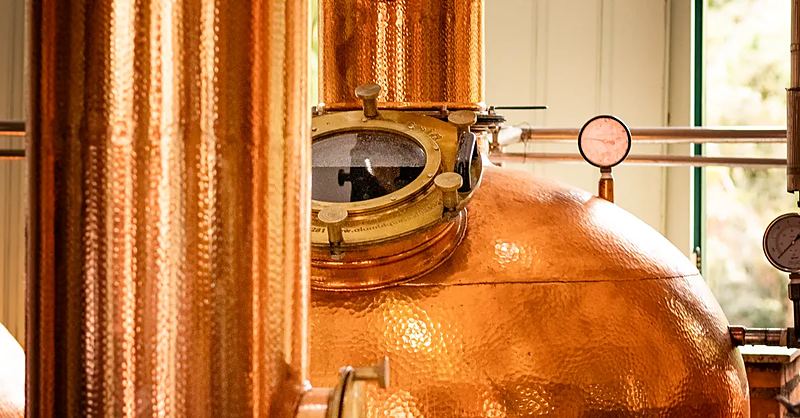
The pot still is the oldest design still in use: a boiler (the pot), a neck or dome above it, and a condenser — with vapour travelling more or less straight from boiler to condenser and only one round of separation, so the spirit that comes off keeps a large share of the wash's flavour compounds — the congeners that give whiskey, rum, and brandy their character. For a fuller comparison of still designs, see Still Types: Pot vs Reflux vs Column.
That flavour retention is both the pot still's strength and its limit. A single pass through a pot still typically produces spirit in the range of 60–70% ABV at best, and the strength falls steadily through the run as the alcohol in the boiler is used up. The separation between fractions is coarse: heads smear into hearts, hearts into tails. Skilful cutting matters more on a pot still than on any other design, because the still itself does little of the sorting for you.
Pot stills are the standard choice for flavourful spirits. Scotch single malt, Cognac, many rums, and traditional moonshine are all pot-still products. If the character of your grain, fruit, or molasses is the point of the exercise, choose a pot still. For neutral spirit for vodka or gin base, it is the wrong choice.
Reflux stills: purity first
A reflux still puts a packed or plated column between the boiler and the condenser. Vapour rising through the column meets liquid condensing and falling back down; the two streams exchange heat, and the vapour is effectively re-distilled many times on its way up. Each plate or section of packing acts like one more small distillation. The packing is usually copper mesh, ceramic saddles, or stainless scrubbers; plated columns use bubble plates instead.
The result is a much sharper separation and a much stronger product: a well-run reflux still can hold 90–95% ABV through most of a run, producing a spirit close to neutral. That is ideal for vodka, gin base, or any spirit that will be flavoured afterwards. The trade-off is the mirror image of the pot still's: most of the flavour compounds are stripped out along with the impurities, so a reflux still is a poor choice for a whiskey or rum where grain or molasses character is wanted.
Many modern stills are hybrids. A column fitted with a dephlegmator — a reflux condenser mounted at the top of the column — lets the distiller control how much vapour is knocked back down, dialling the reflux up or down to run in near-pot mode for a flavourful spirit or full-reflux mode for neutral. If you can only own one still, a flexible column design is the most versatile option.
Stripping runs vs spirit runs
With a pot still, distillers usually split the work into two kinds of run. A stripping run is fast and rough: the wash is distilled hard, with no cuts made, to recover the bulk of the alcohol quickly as low wines — a cloudy, low-strength spirit, typically 25–40% ABV. The goal is volume and speed, not quality, and the run is usually pushed until the output drops to a low strength.
The spirit run is the careful second pass. Low wines (often from several stripping runs, combined) go back into the boiler and are distilled slowly, with the distiller making proper cuts: foreshots discarded, heads and tails set aside, hearts kept. Because the charge is already concentrated alcohol, the spirit run is shorter, the fractions separate more cleanly, and the final product is far better than anything a single fast run would produce.
On a reflux still the distinction is less important, since a single slow run can reach high purity directly. But even reflux distillers often strip first when working with large volumes, because it is faster to strip several batches of wash and then do one careful spirit run than to run each wash slowly through the column.
Single vs double distillation
Single distillation — one pass from wash to finished spirit — is possible on a reflux still and is sometimes done on a pot still for rustic, full-flavoured spirits. It is fast and it keeps maximum character, but it leaves more impurities and makes clean cutting harder, because everything comes off in one compressed sequence.
Double distillation — strip, then spirit run — is the standard for pot-still whiskey and brandy, and it is what most home distillers should plan on. The extra pass costs time and loses a little alcohol at each step, but the improvement in cleanliness and control is large. Some spirits go further: Irish whiskey is traditionally triple-distilled, and some vodka producers distil many times in pursuit of neutrality. Each additional pass strips more character along with more impurities, so there is a point of diminishing returns that depends entirely on what you are making.
Heat sources
How you heat the boiler matters for control, safety, and flavour:
- Electric heating elements (internal immersion elements or external induction plates) are the most common choice for home stills. They offer fine power control, no open flame, and even heating. An element inside the boiler must stay submerged at all times — running one dry will destroy it and can scorch the wash. A power controller is essential: a still needs gentle, adjustable heat, not full power throughout.
- Gas burners (propane or natural gas) deliver a lot of heat quickly and work anywhere, but they put an open flame next to a device that produces flammable vapour. They must only be used outdoors or in a very well-ventilated space, with the burner kept well away from the spirit output, and never left unattended.
- Direct fire (wood or coal under a copper pot) is the traditional method and still used by some commercial distillers, but it is the hardest to control and the least suited to a home setup.
Whatever the source, the key skill is heat management. Too much heat and the run smears — fractions blur together, fusel oils carry over, and the spirit tastes rough. Too little and the run stalls. A slow, steady output (a thin stream, not a gush) is the sign of a well-managed run on either type of still.
Condenser types
The condenser is where vapour becomes liquid again, and an undersized or failing condenser is one of the most common causes of a bad run — or a dangerous one, if vapour escapes uncondensed. The main designs are:
- Worm (coil) condenser. A long coil of copper tubing sitting in a tub of cold water. The oldest design, simple and effective, but it needs a large volume of cold water and the water warms up over a long run, so it must be topped up or circulated.
- Liebig condenser. A straight vapour tube inside a water jacket. Compact, simple to build, and standard on many home pot stills. Its single tube gives less cooling surface than a coil or a bundle, so it needs a good flow of cold water to keep up on a fast run.
- Shotgun condenser. Several parallel vapour tubes inside one water jacket — effectively several Liebigs in one shell. The large surface area handles high vapour flow, which makes it the usual choice for product condensers on larger stills and for reflux columns. Shotgun condensers are also favoured by some Scotch distillers because the extra copper contact helps remove sulphur compounds.
- Dephlegmator (reflux condenser). A condenser mounted at the top of a reflux column, used to knock part of the vapour back down the column as reflux. Controlling its cooling water is how the distiller sets the reflux ratio, and therefore the proof and purity of the output.
Whatever the design, the cooling water should always flow in at the bottom and out at the top, so the jacket stays full, and the output should be checked regularly: distillate coming out warm, or vapour escaping from the end of the condenser, means the cooling cannot keep up and the heat must be turned down.
Choosing your approach
There is no single best setup — only the setup that fits what you want to make. A pot still, double-distilled with careful cuts, is the way to make whiskey, rum, or brandy with real character. A reflux column, run slowly, is the way to make clean neutral spirit for vodka or gin. A stripping run followed by a spirit run is almost always worth the extra time on a pot still. And whichever path you choose, the fundamentals are the same: manage your heat, keep your condenser cold, make your cuts, and never rush a run.
Sources
- Chemistry LibreTexts, “Fractional Distillation of Non-ideal Mixtures (Azeotropes)” — ethanol–water azeotrope at 95.6% ethanol by mass, boiling at 78.2 °C; the limit it sets on distillation. chem.libretexts.org
- All Things Fermented, “Pot Stills vs Reflux Stills: A Beginner's Guide” — pot still output around 60–70% ABV; stripping run then spirit run; flavour retention of pot stills. allthingsfermented.nz
- Distillery University, “Pot Still vs. Column Still” — pot stills rarely past 160 proof (80% ABV) in one pass; each column plate acts as a small re-distillation; dephlegmator control. distilleryuniversity.com
- Still Spirits Help Centre, “Why won't I reach above 60% ABV with the Air Still?” — reflux stills reaching 90%+ ABV; pot still output starting high and falling through the run. help.stillspirits.com
- Home Distiller wiki, “Condenser” — Liebig, worm coil, shotgun, and crossflow condenser designs; shotgun condensers and copper contact. homedistiller.org
- Mile Hi Distilling, “How Does a Still Condenser Work?” — worm, shell-and-tube (shotgun), Liebig, and air-cooled condenser types. milehidistilling.com