Choosing a Still
A still is the most expensive piece of equipment a home distiller buys, and the most common regret is buying the wrong one for the spirit they actually want to drink. A gleaming reflux column is a poor tool for a whiskey lover, and a beautiful copper pot still will never make clean vodka in a single pass. This guide is about matching the still to the spirit, then judging the still itself — its materials, its fittings, its condenser, and the seller behind it — before your money changes hands.
Before you spend a penny, read our guides to safety and legality. Home distillation is restricted or illegal in many jurisdictions, and a still is a machine that boils flammable liquid. Know the law where you live, and know the safety rules, before you start shopping.
Start with the spirit, not the still
The single decision that matters most is what you want in the glass. Flavoured spirits — whiskey, rum, brandy, anything where the character of the wash is the point — need a still that lets flavour through. Neutral spirits — vodka, gin base, the blank canvas for liqueurs — need a still that strips flavour out. No single design does both jobs equally well, and the still that excels at one is, by its nature, a compromise at the other.
So before you compare products, answer one question honestly: what will you make most often? If the answer is one family of spirits, buy the still built for it. If you genuinely want both, and can only afford one still, a hybrid design is the practical answer — but go in understanding that it is a compromise, not a magic trick. The guide to still types explains how each design works in detail; this guide is about choosing between them and judging the hardware.
The main designs at a glance
- Pot still. The simplest design: boiler, head, and condenser, with no column or packing refining the vapour along the way. It keeps the wash's flavour, tops out at modest strength in one pass, and usually needs two runs — a fast stripping run, then a slow spirit run — to produce a finished whiskey, rum, or brandy.
- Reflux still. A tall packed column sits between boiler and condenser, and the operator controls how much vapour is sent back down for re-distillation. Turned up, it produces very clean, high-proof neutral spirit in a single pass; turned down, it lets more character through.
- Column still (plated). Plates inside the column do the same job as packing, with sharper separation between fractions and a more hands-on feel. Home and craft distillers use batch columns charged with one wash at a time; the continuous columns of industrial plants are a different machine entirely.
- Hybrid. A pot-style boiler topped by a short column — plated or packed — with a dephlegmator you can switch on or off. Run it as a pot still for whiskey, as a column still for neutral: one purchase, two personalities, at the cost of added complexity and a higher price.
For how each of these actually works — plates, packing, reflux ratio, and the rest — see the still types guide. The rest of this page assumes you know the broad shape of each design and want to know which to buy.
Three designs worth knowing by name
Beyond the four main families, three particular designs come up so often in shops and forums that they deserve their own introduction.
The alembic
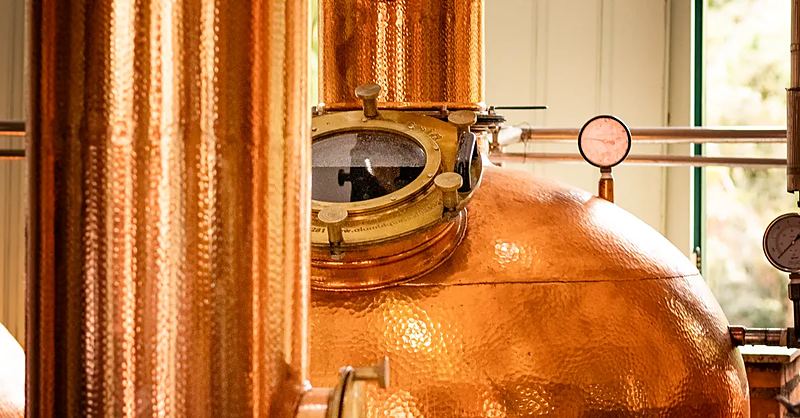
The alembic is the original pot still: a round copper boiler, an onion-shaped domed head, a swan neck, and a coiled condenser (worm) sitting in a water bath. Traditional alembics are hand-hammered from copper sheet about 1 mm thick, and they are still made the same way in Portugal and Spain, where they have distilled brandy and pomace spirits for centuries. They come in small sizes — 3 to 10 litres is common — and a 10-litre alembic charged with a 10% ferment yields roughly 1 to 2 litres per run. An alembic is a fine tool for brandy, whiskey, rum, and gin, but it is a pot still in every practical sense: it keeps flavour, it needs two runs for a polished spirit, and the worm needs a steady supply of cold water.
The air still
An air still is a countertop appliance, closer to a coffee maker than to a traditional still. A built-in fan blows air over the condenser coils, so it needs no water hookup — plug it in and run it on the kitchen counter. The best-known example is the Still Spirits Air Still Pro, a 4-litre dual-mode unit that works as a pot still (up to 80% ABV) or a reflux still (up to 90% ABV), with a botanical basket for gin-style infusion, yielding about 1.1 litres of 40% spirit per 4-litre wash. Air stills suit small spaces and anyone who wants to experiment in tiny batches. Their limit is scale: a 4-litre boiler means a lot of runs for very little spirit.
The T500
The Still Spirits Turbo 500, usually just called the T500, is the most widely sold home reflux still in the world: a packed reflux column and condenser on a 25-litre stainless boiler with a built-in electric element. It distils at up to 93% ABV and yields about 8 litres of 40% spirit from a 25-litre wash — a dedicated neutral-spirit machine for vodka, gin base, and liqueur stock. Two things to know before buying: it uses roughly 200 litres of cooling water per 25-litre run, and it is a reflux still, so it is the wrong tool if your heart is set on whiskey. Still Spirits sells a copper alembic dome that fits the same boiler and turns the T500 into a pot still — a useful upgrade path if your tastes change later.
Matching still to spirit
| Spirit | Best still | Why |
|---|---|---|
| Whiskey and bourbon | Pot still or alembic | Grain character is the whole point; a pot still keeps it, and two runs give the depth |
| Rum | Pot still or alembic | Molasses character survives a pot still; a reflux column would strip it away |
| Brandy and fruit spirits | Alembic or pot still | Delicate fruit notes need gentle, flavour-keeping distillation |
| Vodka and neutral spirit | Reflux still, column still, or T500 | High proof and a clean profile in one pass |
| Gin | Reflux still for the base, plus a pot still or botanical basket for infusion | Clean neutral base first, botanical character added second |
| Liqueurs and infusions | Any neutral source; an air still is fine for small batches | The flavour comes from what you add after distillation |
| Essential oils and hydrosols | Alembic with a worm | The traditional tool for the job, with a herb basket for steam distillation |
What to look for when buying
Once you know the design, judge the hardware. The differences between a still that serves you for a decade and one that frustrates you from the first run are mostly in the details below.
Materials and build quality
Copper and stainless steel are the only accepted materials for a still, and the full reasoning is in our equipment guide. When buying, check the specifics. For copper, look for sheet at least 1.0 mm thick — 1.0 to 1.2 mm is the standard for quality home stills, while cheap imports at 0.5 to 0.7 mm dent easily and wear out faster. For stainless, look for food-grade 304 or 316, with smooth, even welds. Ask the seller, in writing, what solder was used: every joint must be lead-free, food-safe solder, and a seller who cannot answer that question is telling you something. Hand-hammered copper alembics are the traditional standard; machine-pressed ones are cheaper but thinner and less durable.
Fittings: tri-clamp vs threaded
How the parts of a still join together matters more than most buyers expect. Tri-clamp (also called tri-clover) fittings are the sanitary standard of the brewing, dairy, and pharmaceutical industries: two flanged ferrules, a gasket, and a clamp that pulls them together. They have no threads and no crevices, so there is nowhere for residue to hide; they come apart in seconds for cleaning; and their sizes are standardised, so parts from different makers usually fit. Their downsides are cost and bulk. Threaded (NPT) fittings are cheaper and more compact, but threads trap residue, need PTFE tape to seal, and are a chore to strip down and clean. For the vapour path, tri-clamp is the better choice and worth paying for; threaded fittings are fine for the cooling-water circuit, where they never touch spirit.
Condenser capacity
An undersized condenser is the most common design fault in a still, and the most dangerous: vapour that is not fully condensed escapes as flammable vapour instead of dripping out as liquid. Ask the seller for the condenser's specifications — coil length for a worm, tube size and length for a Liebig — and be wary of any listing that omits them. As a rough yardstick, a 20-litre still needs at least 80 to 100 cm of worm coil to condense vapour fully at normal run speeds, and a home-built Liebig is commonly two to three feet long, with a ½-inch vapour tube inside a ¾-inch water jacket. A condenser with spare capacity is a safety margin, and it lets you run faster on stripping runs without vapour escaping.
Boiler size and headroom
A boiler is never filled to the brim. Wash froths up as it comes to the boil, and a boiler charged too full will push foam and wash up into the head and condenser — a mess at best, and a blocked vapour path at worst. The working rule is to charge the boiler to about two-thirds of its rated volume, and to size the boiler to your fermenter with that headroom in mind. Our still types guide works through the sizing in detail, including why a 5-gallon fermenter pairs with an 8-gallon boiler. Also check the total height of the assembled still against your space: a tall reflux column under a low ceiling is a problem you want to discover before delivery, not after.
Warranty and seller reputation
A still is a long-lived purchase, and the seller's after-sales support matters. Established makers offer real warranties — the T500 and the Air Still Pro both carry three-year warranties — and publish full specifications, manuals, and spare-parts lists. Before buying from a smaller maker or an overseas marketplace, check the home distilling forums: the community is quick to praise good makers and quicker still to warn about bad ones.
Red flags and second-hand cautions
Some warning signs should stop a purchase outright:
- No mention of solder type. If the listing does not say lead-free, assume the worst and walk away.
- A price far below the market. A quality 10-litre copper still costs roughly $200 to $350; a $50 still at that size is thin copper, lead solder, or both.
- No maker, origin, or specification. A legitimate seller tells you who made the still, where, from what, and to what dimensions.
- Silicone or plastic in the vapour path. Cheap imported stills often ship with silicone gaskets, silicone tubing, or plastic parts where vapour passes. Hot ethanol vapour attacks these materials; they must be replaced with flour paste, PTFE, or proper gaskets before the still is used — or the still avoided altogether.
- Aluminium or galvanised steel anywhere near wash or vapour. Both react with acidic vapour and have no place in a still.
- A vapour path that can be shut off. The condenser outlet is how vapour escapes to the open air. Any design with a valve that could close the vapour path, or an outlet that could be capped or submerged, is dangerous by design.
Second-hand stills deserve extra caution. An old still may have been soldered with lead — lead solder looks identical to lead-free solder, and the only safe assumption is that an unknown joint is leaded until you have proof otherwise. Inspect every joint for dents, cracks, and green corrosion on copper, and ask the seller why they are selling. If you do buy used, replace all gaskets, run a water test for leaks, and put the still through the full cleaning routine — vinegar run and sacrificial alcohol run — before it produces a drop you plan to drink.
Sources
- Still Spirits, “T500 Distilling System” — 25 L boiler, up to 93% ABV, about 8 L of 40% spirit per 25 L wash, roughly 200 L cooling water per run, 3-year warranty. stillspirits.com
- Still Spirits, “Air Still Pro” — 4 L capacity, dual pot/reflux modes, up to 80% ABV in pot mode and 90% in reflux mode, about 1.1 L of 40% spirit per 4 L wash, 3-year warranty. stillspirits.com
- CopperHolic, “Buying a Copper Still in the USA: 2026 Guide” — 1.0–1.2 mm copper as the quality standard, lead-free solder as non-negotiable, 80–100 cm worm coil for a 20-litre still, price and red-flag guidance. copperholic.com
- Maritas Stills, “Whiskey Alembic 10 liters” — 1 mm hand-hammered copper, 10–15% yield from a 10% ferment, about 1–2 litres per run. maritastills.es
- Hobby Distillers, “How to Choose a Copper Still” — fill the boiler about two-thirds full, 100% copper at least 1 mm thick with lead-free tin-silver solder. hobbydistillers.com
- Deutsche Beverage Parts, “Tri-Clamp Connections” — tri-clamp fittings as the sanitary standard, no threads or crevices, quick assembly and disassembly, standardised sizing. parts.deutscheequipment.com
- Home Distiller forum, “Liebig Condenser Length” — home builders commonly run a Liebig two to three feet long, with a ½-inch inner tube in a ¾-inch jacket. homedistiller.org
- Home Distiller forum, “So, you got a cheap Chinese still… now what?” — silicone gaskets and tubing in cheap imports must be removed; flour paste and PTFE as replacements. homedistiller.org