Equipment & DIY Builds
A pot still is a simple machine — a boiler, a vapour path, and a condenser — and building one yourself is entirely achievable with basic metalworking skills. But it is also a machine that holds boiling flammable liquid, and every shortcut in materials or design is a hazard you will live with on every run. This advanced guide covers what to build from, what to avoid, and where buying beats building.
Read the Safety guide and the Legality guide before you build anything. A still is only as safe as its weakest joint, its most blocked passage, and its least careful operator. If you cannot solder a watertight joint, wire a circuit to code, or tell copper from brass at a glance, start by practising those skills on scrap — or buy a complete still and spend your effort learning to run it well.
Anatomy of a pot still
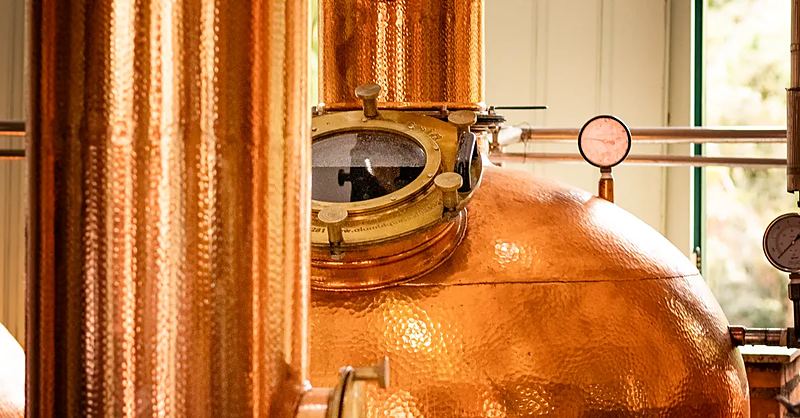
Every pot still, from a two-gallon hobby rig to a commercial whiskey still, has the same four parts. The boiler holds the wash and is heated until it boils. The head — a riser, lyne arm, or onion dome — carries vapour away from the boiler. The condenser cools that vapour back into liquid: either a coil of copper tube sitting in a bucket of cold water (a worm), or a straight tube jacketed by a flow of cooling water (a Liebig condenser). And the collection point is where the distillate drips out, always open to the air. A thumper — a small secondary vessel between boiler and condenser — is an optional extra that effectively distils the vapour a second time, but it is not required, and it adds joints and failure points.
Keep the vapour path short, smooth, and downhill wherever possible. Every unnecessary bend is a place for liquid to pool and for pressure to build if something blocks; every joint is a place for flammable vapour to leak. A good build has as few joints as you can manage, and each one is either soldered, welded, or sealed with a proper clamp and gasket.
Safe materials — and forbidden ones
Two metals are accepted for still construction, and the choice between them is mostly a matter of cost, skill, and taste:
- Copper. The traditional material. It conducts heat well, is easy to cut, bend, and solder with ordinary plumbing tools, and — usefully — it reacts with sulfur compounds in the vapour, stripping out the rotten-egg notes that yeast produces. That is why even mostly stainless stills usually include some copper in the vapour path, such as copper mesh or a copper condenser. Its downsides are cost, weight, and maintenance: copper tarnishes and needs regular cleaning (see the cleaning guide).
- Stainless steel. Strong, neutral, and almost maintenance-free. A converted stainless beer keg is a common DIY boiler in the hobby for good reason: it is already a pressure-rated vessel with a convenient opening. Stainless does not remove sulfur compounds the way copper does, so a stainless boiler is usually paired with copper in the column or condenser. It is also harder to work — it needs proper welding or purpose-made fittings rather than a soldering iron.
Joining matters as much as the metal. Copper parts are usually soldered, and the solder must be lead-free — food-grade silver solder is the usual choice. Lead solder must never be used anywhere in a still: lead leaches into the distillate, and lead poisoning is a slow, serious business. If you are buying second-hand copper parts or an old still, assume the solder is lead until you have proof otherwise, and do not use it. Stainless joints should be welded (TIG) or made with tri-clamp fittings; brazing stainless with silver solder is also done, but it needs the right flux and practice.
A word on brass: brass fittings are common in plumbing, and some brass contains lead. Brass that is certified lead-free and rated for drinking water is generally accepted for small fittings such as valves and thermometer ports, but if a fitting's composition is unknown, leave it out. The same rule applies to anything salvaged: if you cannot identify the metal, it does not go in the still.
Pressure safety: never a sealed system
This is the single most important design rule in distilling, and it is absolute: a still must always be open to the atmosphere. A closed still builds pressure as the wash boils, and a boiler full of hot alcohol under pressure is a bomb. Every still must have a vapour path that ends in an opening to the air — normally the outlet of the condenser — with nothing that can close it off.
In practice that means:
- No valves in the vapour path that could be shut during a run. If your design includes a valve anywhere between the boiler and the open outlet, it must be physically incapable of being closed while the still is hot — and the safest version of that is not having one at all.
- An open condenser outlet. The end of the condenser, where distillate drips out, must never be capped, submerged in liquid, or connected to a sealed container. Collection vessels sit open below the outlet.
- Nothing that can block the path. Packing, mesh, or a thumper that floods can choke the vapour path. Design so that a blockage anywhere still leaves vapour an escape route, and check the path is clear before every run.
- Know the warning signs. A still that hisses, bulges, sprays vapour from a joint, or suddenly stops producing while the boiler is still boiling is a still under pressure. Kill the heat immediately, get clear, and let it cool before you investigate — never try to open or adjust a pressurised still.
Some builders add a dedicated pressure-relief device as a second line of defence — for example, a commercial relief valve rated well below the vessel's limits. That is sensible belt-and-braces engineering, but it is not a substitute for an open vapour path. Relief devices can stick, clog, or be fitted wrong; an open outlet cannot fail shut.
Fermenters: plastic, glass, or stainless
Fermentation is far more forgiving than distillation — the liquid is cool, the alcohol is weak, and nothing is under pressure — so the material rules relax considerably. All three common options work; the choice is about size, weight, and how much you want to spend.
| Material | Pros | Cons |
|---|---|---|
| Food-grade HDPE plastic (buckets, drums) | Cheap, light, available in large sizes, will not shatter | Scratches harbour bacteria; can absorb odours over time; opaque, so you cannot watch the ferment |
| Glass carboys and demijohns | Non-porous and easy to sanitise; you can see the ferment; no flavour pickup | Heavy and fragile — a full carboy is awkward and a dropped one is dangerous; limited to smaller batches |
| Stainless steel | Durable, easy to clean, no flavour pickup, lasts indefinitely | Expensive; heavy; opaque |
Whatever you use, it must be food-grade: a bucket that once held paint or chemicals is never safe for fermentation, however well you wash it. The fermenter needs a lid that keeps out dust and insects while letting carbon dioxide escape — either a loose lid or a proper airlock. A sealed fermenter is a pressure vessel in miniature, and a vigorous ferment can blow a tight lid off or split a glass carboy. For a first setup, a food-grade HDPE bucket with a lid and an airlock is the standard recommendation: cheap, light, and big enough for a full 25 L wash.
Heating: electric elements vs gas
Heat is what makes a still work, and the choice of heat source shapes the whole build — where you can run it, how precisely you can control it, and what can go wrong.
Electric immersion elements
An electric water-heater element mounted through the wall of the boiler is the most popular choice for home stills, and usually the best one. There is no open flame, so the fire risk is far lower; there are no combustion fumes, so ventilation is simpler and the still can run indoors; and with a proper controller the heat is repeatable to the watt. The drawbacks are electrical: the element needs a circuit that can carry its load (larger elements may need a 240 V outlet), all wiring must be enclosed in approved boxes and meet local electrical code, and the seal where the element passes through the boiler wall must be watertight. Low-density (ULWD) elements, which spread their power over a large surface, are preferred over standard screw-in water-heater elements because they are far less likely to scorch the wash — especially important for grain mashes with solids in them, which can bake onto a hot element.
An element on its own is not enough: you also need a controller. A bare element runs at full power or not at all, and full power through a spirit run will overwhelm the condenser and smear your cuts. Controllers range from simple phase-angle (triac) or burst-fire units to solid-state relays driven by a temperature or power controller. Note that a controller adjusts the rate of boiling, not the boiling temperature — the temperature of a boiling wash is set by its alcohol content, and turning up the heat only makes it boil faster. That rate control is what you are buying: gentle heat for a spirit run, full power for a stripping run.
Gas and propane burners
A propane burner under the boiler is simple, portable, and needs no wiring — and it is the heat source most associated with distilling accidents. An open flame sits a short distance from a vessel full of flammable vapour and a collection jar full of high-proof spirit; a spill, a knocked-over jar, or a vapour leak near the flame can ignite in an instant. Gas burners also produce carbon monoxide when combustion is incomplete, so they demand serious ventilation and are best used outdoors. Heat control is coarser than electric — the flame changes as cylinder pressure drops — and the concentrated heat can scorch a mash where the flame meets the boiler. Gas is a reasonable choice only where electricity genuinely is not available, and then only outdoors, on a stable surface, with a fire extinguisher in reach and the collection vessel as far from the flame as the setup allows.
Stovetops and hot plates
A kitchen stove or a hot plate works for a small still, but most household elements cycle on and off too slowly for fine control, which makes the output surge and stall. They are a workable starting point for a small boiler; for anything larger, a dedicated element and controller, or a proper burner, is a real improvement.
What to buy vs what to build
Building everything yourself is satisfying, but some parts are better bought. A sensible split:
- Build: the copper head, riser, and condenser, if you can solder cleanly — these are straightforward plumbing work, and a Liebig condenser is little more than two concentric tubes. A converted keg boiler is also a classic DIY project if you can weld or fit a bolted flange.
- Buy: the heating element and controller (mains-voltage parts with safety certification are not a DIY electronics project); thermometers and any digital instrumentation; tri-clamp fittings, gaskets, and valves, which are cheap bought and fiddly to fabricate; and the boiler itself if you cannot weld stainless — a ready-made boiler with proper fittings is money well spent.
- Buy first, build later: if this is your first still, consider buying a complete pot still kit and learning to run it before you build. You will learn what matters — condenser capacity, joint quality, heat control — by using a working still, and your second still, the one you build, will be far better for it.
Whatever you build, put it through the full cleaning routine before its first real run: a vinegar run and a sacrificial alcohol run exist precisely because new construction leaves flux, oxides, and residues inside the metal. A new still is not ready to make drinkable spirit until it has been cleaned that way.
Sources
- HomeDistiller, “New Distiller's FAQ” (wiki) — safe materials are copper and stainless steel; avoid lead solder, unknown metals, and unsafe plastics in the vapour path; hot ethanol vapour dissolves plastics and extracts chemicals; HDPE is acceptable for fermentation. homedistiller.org
- HomeDistiller, “New-Distiller's Mini-FAQ” — all stills must be open to the atmosphere and must never be closed; lead-free, preferably food-grade solder only; “there is no safe usage of plastics in the distillation process.” homedistiller.org
- HomeDistiller wiki, “Heat Source” — stovetop elements cycle too slowly for fine control; electric immersion elements are cleaner and safer with no open flame but need a controller (phase-angle, burst-fire, or solid-state relay) and code-compliant wiring; larger stills are usually heated by propane burner or internal electric element. homedistiller.org
- Hi Proof Products, “All About Moonshine Still Electric Heaters” — a controller is needed to control the rate of vaporisation; turning up the heat increases the boil rate, not the boiling temperature, which is set by the wash ABV. hiproofproducts.com
- Samovar, “Safety Rules for Distillation and Rectification” — prefer electric heating without an open flame; a gas burner adds an ignition source and a carbon monoxide risk; electrical connections should be left to a qualified electrician, with protective earth, circuit breaker, and residual-current device checked. samovar-tool.ru
- Destylatory Miedziane, “Which heating should I choose? Gas or electricity?” — gas regulation is less precise and less repeatable than an electric regulator; gas burners can scorch the mash where flame meets boiler; ULWD electric heaters spread power over a large surface and avoid burning. destylatorymiedziane.pl
- StillDragon, “Is Silicone Safe for Distilling?” — gaskets should be replaced every one to two years as preventative maintenance; PTFE and silicone gaskets are both FDA-approved food-safe options, with PTFE less flexible and prone to loosening as the still heats. stilldragon.com
- StillZ, “Why Your Moonshine Tastes Metallic: Causes & Fixes” — aluminium reacts with acidic vapours and can leave a metallic note; lead-based solder is the worst offender for contamination; copper binds sulfur compounds, stainless is neutral. blog.stillzstore.com
- Clawhammer Supply, “Corn Mash Recipe — How To Make Corn Moonshine” — a 6.5-gallon glass carboy as a preferred fermentation vessel. clawhammersupply.com