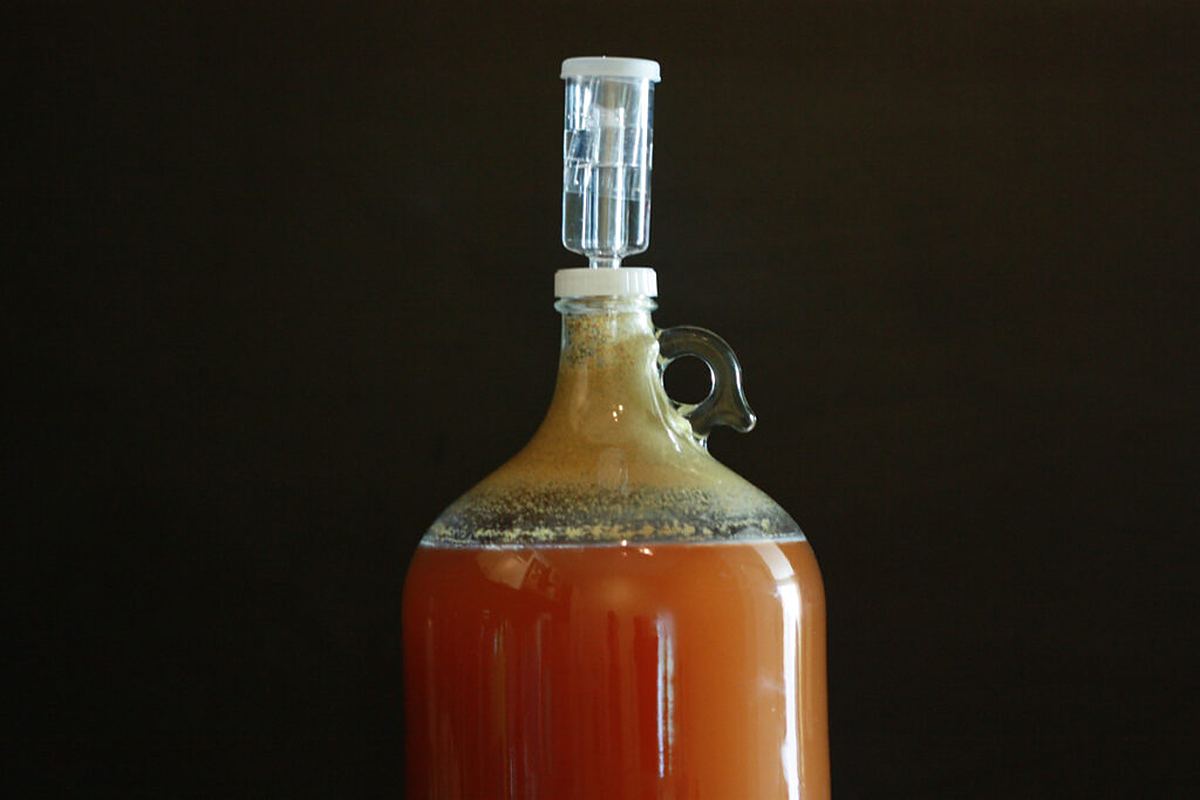
Fast Fermenting Vodka (FFV)
The quickest honest route to a neutral spirit: a bran-fed sugar wash that ferments dry in three to four days instead of two weeks, with no carbon filtering and no clearing chemicals. It trades a little extra preparation — half an hour simmering bran — for a fermentation that is over before most washes have properly started.
Before you start: read the Safety guide first. Fermentation itself is low-risk, but everything this wash is destined for involves flammable vapour, high temperatures, and — in many places — legal restrictions; the Legality guide explains the legal picture. You will need a hydrometer to follow this recipe — the gravity readings tell you when the wash is done.
FFV — also written TFFV, for Ted's Fast Fermenting Vodka — comes from a New Zealand home distiller known as Teddysad, who published it in 2015 and refined it in the years since through the Australian and New Zealand distilling forums. It has since become one of the most widely made neutral washes in the hobby, and it is easy to see why: the ingredients cost very little, the method is short, and the finished wash is a clean, lightly wheaty neutral that runs well through a reflux still and takes flavouring, gin botanicals, or oak without complaint.
The speed is not a trick of turbo yeast or an overload of sugar. It comes from the opposite approach: a modest starting gravity, a generous yeast pitch, and a nutrient package that gives the yeast everything it needs at once, so the colony grows fast and works at full pace from the first hours. The recipe's author reports consistently reaching dryness in 84 to 96 hours, and other makers report the same three-to-four-day window, with some batches taking five days. What it asks of you in return is precision: steady temperature, the full nutrient list, and no shortcuts on the bran preparation. This is a recipe that rewards following it exactly the first time.
Why it works
Plain sugar water is a poor home for yeast — it has energy in abundance and almost nothing else. FFV fixes that with four complementary nutrients, each covering a gap the others leave. The wheat bran is the workhorse: it carries a broad spread of B vitamins (roughly 20–30 mg per 100 g across the B group), minerals including zinc, iron, and manganese, and a mass of insoluble fibre that gives the yeast cells something to cling to. Simmering the bran for half an hour draws those nutrients out into the water and makes them consistent from batch to batch, which is part of why the recipe is so repeatable.
The DAP — di-ammonium phosphate, sold at homebrew shops as yeast nutrient — supplies nitrogen, the nutrient sugar washes lack most acutely and the one that most directly limits how fast yeast can multiply. The crushed multivitamin tablet tops up the B vitamins, and the pinch of Epsom salts supplies magnesium, which is the one mineral wheat bran does not provide. Skip any one of these and the ferment still finishes — bakers yeast is hard to kill — but the speed is the first thing to go: makers who leave out the Epsom salts have reported the wash sprinting to 1.010 in two or three days and then stalling, needing another week to creep down to 0.990.
The other half of the speed is restraint. The starting gravity is only about 1.060, far gentler than the 1.090 ceiling of a tomato-paste wash, so the yeast is never pushing against osmotic stress or rising alcohol while it is still trying to grow. A big pitch — about 54 g of dried bakers yeast in this 25 L batch — means the colony is large from the outset, and a warm, steady fermentation temperature near 29 °C keeps it in its fastest metabolic gear. The recipe's author developed it with ordinary bakers yeast, and any good bakers yeast will do; there is no need for a specialised distillers strain.
Ingredients
The original recipe is written for a 23 L wash; the quantities below are scaled proportionally to 25 L, keeping the same starting gravity.
- 4.35 kg white sugar
- 272 g wheat bran (baking bran or miller's bran — not breakfast cereal)
- 1 tablet multivitamin, crushed (plain tablets, not fish-oil capsules)
- A pinch of Epsom salts (magnesium sulfate)
- 0.5 tsp DAP (di-ammonium phosphate, or wine yeast nutrient)
- 0.5 tsp citric acid, to bring the pH to about 5
- 54 g dried bakers yeast
- Water to make up the batch volume
Method
- Bring 2–3 L of water to the boil in a large pot (5 L or bigger). Add the bran a little at a time, stirring as you go — tipping it all in at once can make the pot boil over. Bring it back to a boil, then turn the heat down and let it bubble gently for half an hour, giving it a stir now and then, until the mixture thickens into a runny porridge.
- While the bran simmers, stir the sugar into warm water until it has dissolved, then pour the syrup into the fermenter, topping up with cool water to about 22 L.
- Stir in the crushed multivitamin tablet, the Epsom salts, and the DAP.
- Add the hot bran porridge to the fermenter and stir it through, then top up with water to the full batch volume.
- Use the citric acid to bring the pH down to roughly 5 — about half a teaspoon usually does it. A pH meter or test strips will confirm it; if you have neither, the half-teaspoon measure is what the recipe's author uses.
- Check the temperature: it must be below 30 °C before the yeast goes in. Rehydrate the yeast in about 100 mL of warm water, then pitch it into the wash.
- Take a hydrometer reading. You should see a starting gravity near 1.060. Then stir the wash vigorously to aerate it — a stick blender works well — because the yeast needs oxygen for its initial growth phase.
- Leave plenty of headroom: use a 30 L fermenter for this 25 L batch. Do not seal the fermenter for the first 24 hours — a thick, foamy cap forms within the hour, and a sealed lid would have nowhere to vent. Rest the lid loosely on top, and fit an airlock only after about 36 hours, once the most violent stage has passed.
- Keep the fermenter warm and steady, near 29 °C if you can. The wash should ferment dry to about 0.990 within 3–4 days. When the gravity is stable, siphon the wash off the sediment into a clean vessel and give it a couple of days to settle clear before it goes anywhere near the still.
Expected results
A wash starting at 1.060 and finishing at 0.990 comes out at about 9.2% alcohol by volume — the wash ABV calculator gives 9.2% from those readings, and a published 30 L variant of the recipe at a starting gravity of 1.061 reports a potential of 9.4%. A 25 L batch at 9.2% holds about 2.3 L of pure alcohol. Expect to keep roughly 1.8 L of it as high-strength spirit after the foreshots, heads, and tails come off. The recipe's author strips several ferments through a pot still and combines the low wines for a slow spirit run through a reflux column, which is the usual route to a clean vodka from this wash.
On timing, expect dryness in 3–4 days (84–96 hours is the figure the recipe's author reports consistently). Some makers finish in 3 days, others in 5; a batch that races to 1.010 and then slows is usually short of magnesium or has been allowed to cool. In short: starting gravity about 1.060, final gravity about 0.990, about 9.2% ABV, and roughly 1.8 L of spirit from a 25 L batch.
Tips
- Keep the temperature steady, not just warm. This wash is tuned for speed inside a fairly narrow window — around 29 °C, held steady. A fermenter that swings between warm days and cold nights will still finish, but the three-day ferment can stretch into a two-week one. An aquarium heater or a heated belt earns its keep here.
- Never use fish-oil multivitamins. Plain multivitamin or B-vitamin tablets are what the recipe wants. Capsules containing fish oil will carry their smell right through the still and into the finished spirit.
- Add the bran gradually to the boiling water. Bran swells fast and foams hard; dumping the whole measure in at once is the classic way to flood a stove top. Stir it in a spoonful at a time.
- Respect the foam. The first day of this ferment is genuinely violent — the foamy cap rises within an hour of pitching. The 30 L fermenter and the unsealed first day are not optional extras; they are what keeps the wash in the vessel.
- Try the Mk II variation once you know the base recipe. The recipe's author later swapped some of the bran for kibbled rye — 200 g of bran and 100 g of kibbled rye in the original 23 L batch — and found it just as fast with a little more bite in the finished spirit. Replacing about 50 g of the bran with rolled oats gives a smoother mouthfeel instead.
- Do not bother reusing the trub. The recipe's author tried running later generations on the spent yeast and found the results fell away; the wash is cheap enough that a fresh pitch every time is the better deal.
Sources
- Teddysad, “Ted's Fast Fermenting Vodka” (HomeDistiller forum, 2015) — the original 23 L recipe: 4 kg sugar, 250 g wheat bran, multivitamin, Epsom salts, ½ tsp DAP, citric acid, 50 g bakers yeast; bran simmered 30 minutes; pitch below 30 °C; do not seal for 24 hours, airlock after 36 hours; dry to 0.990 in 3–4 days, 84–96 hours consistently; SG about 1.060; Mk II with 200 g bran and 100 g kibbled rye. homedistiller.org
- DIY Distilling, “The 3 Best Sugar Wash Recipes (For Home Distilling)” — independent restatement of the recipe confirming the same ingredients, quantities, and 3-day, 1.060-to-0.990 figures. diydistilling.com
- HomeDistiller forum, Ted's Fast Fermenting Vodka discussion (p. 22) — wheat bran's B vitamins, minerals, and insoluble fibre; bran carries no magnesium, hence the Epsom salts; Epsom salts fixing a slow tail to 0.990; Ted's 2024 notes on bakers yeast and the rye/oats variations; wine yeast nutrient as a DAP substitute. homedistiller.org
- HomeDistiller forum, Ted's Fast Fermenting Vodka discussion (p. 27) — the recipe works in a narrow window; stable temperature near 29 °C is mandatory; the long bran boil makes nutrients consistent batch to batch; a reflux still is the right tool for the spirit run. homedistiller.org
- HomeDistiller forum, Ted's Fast Fermenting Vodka discussion (p. 20) — bran tipped into boiling water overflows; add it gradually. homedistiller.org
- HomeDistiller forum, Ted's Fast Fermenting Vodka discussion (p. 6) — 30 L variant at SG 1.061 with 9.4% potential ABV, corroborating the 9.2% figure. homedistiller.org